<?xml version="1.0" encoding="utf-8"?><feed xmlns="http://www.w3.org/2005/Atom" ><generator uri="https://jekyllrb.com/" version="3.10.0">Jekyll</generator><link href="https://seenby.urlocalcyb.org/feed.xml" rel="self" type="application/atom+xml" /><link href="https://seenby.urlocalcyb.org/" rel="alternate" type="text/html" /><updated>2026-04-16T01:27:19+00:00</updated><id>https://seenby.urlocalcyb.org/feed.xml</id><title type="html">UR LOCAL CYBORG</title><subtitle>new media art reviews</subtitle><entry><title type="html">“Frankenstein” (2025) dir. Guillermo del Toro</title><link href="https://seenby.urlocalcyb.org/2025/10/26/guillermo-del-toro-frankenstein.html" rel="alternate" type="text/html" title="“Frankenstein” (2025) dir. Guillermo del Toro" /><published>2025-10-26T00:00:00+00:00</published><updated>2025-10-26T00:00:00+00:00</updated><id>https://seenby.urlocalcyb.org/2025/10/26/guillermo-del-toro-frankenstein</id><content type="html" xml:base="https://seenby.urlocalcyb.org/2025/10/26/guillermo-del-toro-frankenstein.html"><![CDATA[<p><strong><em>Frankenstein</em> (2025) dir. Guillermo del Toro</strong><br />
<small>Date seen: October 24, 2025</small><br />
<small>Date reviewed: October 26, 2025</small></p>

<p><small>SPOILERS for both Mary Shelley’s <em>Frankenstein</em> and Guillermo del Toro’s adaptation ahead.</small></p>

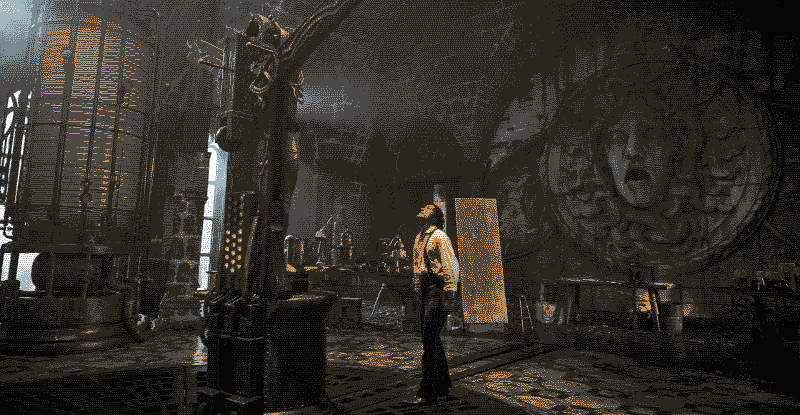
<p><img src="/assets/images/2025-10-26/frank1.jpg" alt="Victor beholds the Creature in his lab" /></p>

<p>In directing <em>Frankenstein</em>, Guillermo del Toro knew he had one chance to get it right, and that’s why he waited so long. I read del Toro’s introduction to <em>THE NEW ANNOTATED FRANKENSTEIN</em>, written in 2017, and gleaned his connection with with Mary Shelley’s original tale profoundly. And indeed, his adaptation brings to life the grandiosity that is Romantic prose, with rich and indulgent color and costuming, and formidable sets that capture the extravagance of aristocratic wealth, the sublime of the natural world, and the spectacle of mad science in the popular imagination. Like Shelley’s novel, the true horror lies not in the blood and the gore but in the humanity (and lack thereof) of monsters and the men who make them.</p>

<p>But to call this film a faithful adaptation of Mary Shelley’s “Miltonian tragedy”, as the director and press insinuated, is a gross and elementary simplification. I suppose “faithful,” in the Frankenstein cinematic universe, only means that Robert Walton exists and that the scientist’s given name is Victor, both of which are true for del Toro. But this adaptation obliterates the nuance of the original novel by exaggerating the Creature as a victim and Victor as a villain. We no longer get to watch the young scientist’s transformation from misguided student to irredeemable narcissist because del Toro’s Frankenstein is despised from the start: spoiled and disliked by his own father, and eventually his younger brother and Elizabeth (who, by the way, is <em>neither</em> related to the Frankensteins nor primarily Victor’s romantic interest in this adaptation. While the original Victor called Elizabeth “sister,” del Toro’s Victor pines for his brother’s fiancée, who he calls sister-in-law). Meanwhile, we never get to question whether the Creature was justified in killing William, Henry, and Elizabeth, and in framing Justine, because del Toro’s Creature only killed William in self-defense, Justine and Henry as characters were omitted entirely, and Elizabeth was killed <em>not by the Creature himself</em> but by Victor Frankenstein’s misfire. The black-and-white characterization and the removal of critical characters serves del Toro’s interpretation of the novel — albeit a common and valid one, where the man himself is the monster — but leaves no room for another conclusion, or capacity to empathize with the scientist at all.</p>

<p>Del Toro clearly draws from Kenneth Branagh’s 1993 adaptation, which he described as having a “pretty much perfect” script, most notably in the “naked Eureka” scene and Victor’s request to the Creature to “say my name.” I see Branagh’s adaptation as a tribute to Mary Shelley’s <em>Frankenstein</em>, and the best compromise between book-accuracy and cimenatic brevity I’ve seen so far. Meanwhile, I see del Toro’s Frankenstein a well-produced tribute to every other tribute to Mary Shelley’s <em>Frankenstein.</em> Although the aging-up of William is unique — no other <em>Frankenstein</em> director seems to pass up the opportunity to kill an innocent child — as is having him marry Elizabeth, there is no other plot point of this film that I have <em>not</em> seen in a Frankenstein adaptation before.</p>

<p>But I will stop harping on loyalty. Film and prose are different mediums, so of course some translation is necessary — and just because the movie was different from the book doesn’t mean it was a bad movie on its own. I enjoyed my experience of watching this film, the first del Toro film I have watched. The horror is vivid but not overdone, and the lush imagery stunned and thrilled me. The bloody crimson of Victor’s gloves, the magnificent turquoise of Elizabeth’s dress, the grotesque yet sympathetic stitches of the Creature’s design, the glamorous wedding! The steampunk lab! The mirrors that Victor always stops to look into like the self-obsessed brat that he is. Frankensteins are often broody and stormy but del Toro’s Frankenverse had frills. Oscar Isaac and Jacob Elordi breathed such angst and tenderness into their respective characters, and I particularly liked the tenderness of their interactions during the Creature’s “infancy” — among the only scenes allowing Iscar Isaac’s Victor to show humanity. What made this movie worth the watch was the prowess of the leading actors and the quality of the production — 3.5/5 stars. I’m glad I caught it in theaters. I can’t say I’ll watch it again.</p>

<p><img src="/assets/images/2025-10-26/frank2.jpg" alt="Victor broods" /></p>

<hr />

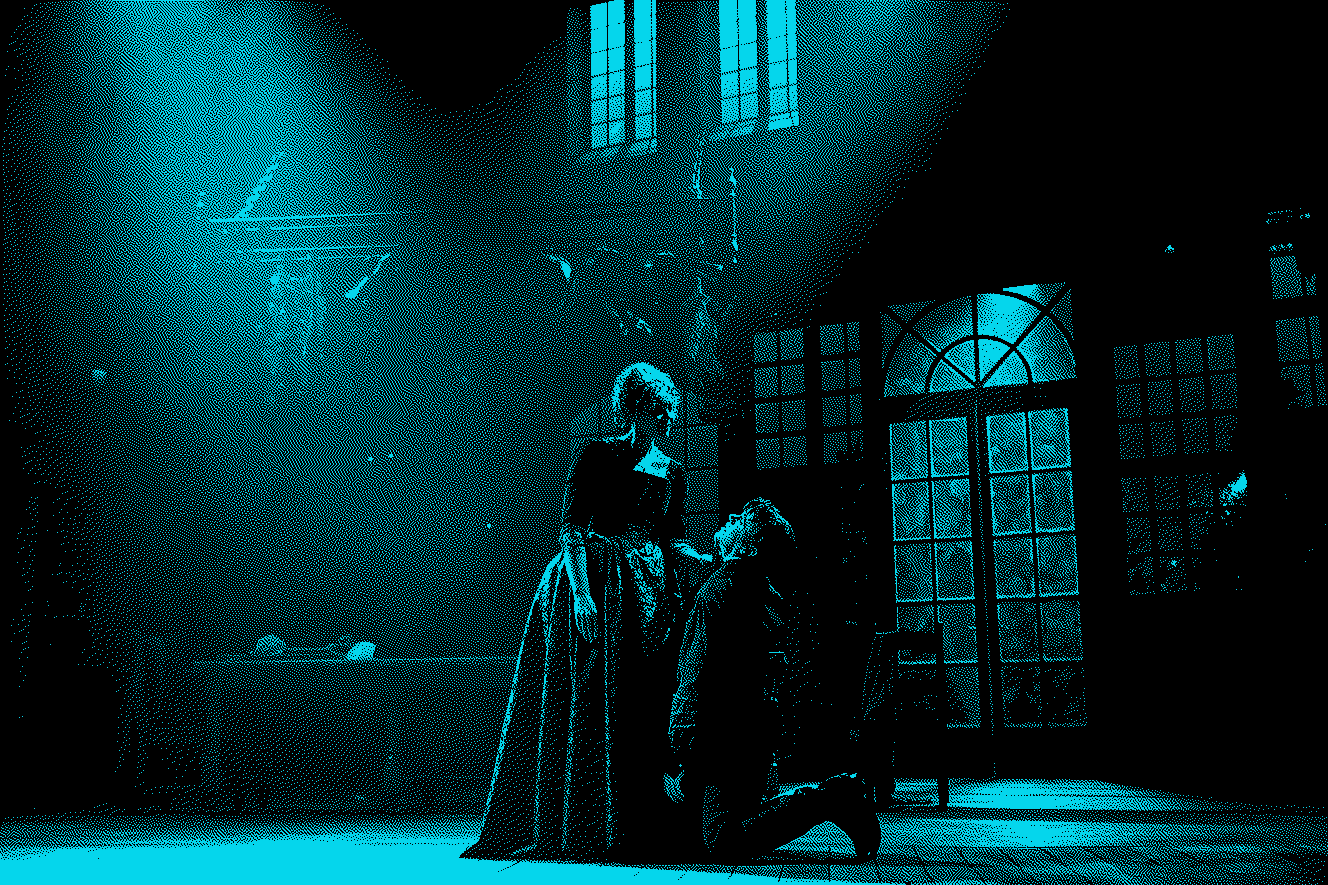
<p><small><a href="https://letterboxd.com/film/frankenstein-2025/"><em>Frankenstein</em> (dir. Guillermo del Toro)</a> screened in select theaters October 17-24, 2025, and will be released on Netflix on November 17.</small></p>]]></content><author><name></name></author><category term="review," /><category term="movie" /><summary type="html"><![CDATA[Frankenstein (2025) dir. Guillermo del Toro Date seen: October 24, 2025 Date reviewed: October 26, 2025 SPOILERS for both Mary Shelley’s Frankenstein and Guillermo del Toro’s adaptation ahead. In directing Frankenstein, Guillermo del Toro knew he had one chance to get it right, and that’s why he waited so long. I read del Toro’s introduction to THE NEW ANNOTATED FRANKENSTEIN, written in 2017, and gleaned his connection with with Mary Shelley’s original tale profoundly. And indeed, his adaptation brings to life the grandiosity that is Romantic prose, with rich and indulgent color and costuming, and formidable sets that capture the extravagance of aristocratic wealth, the sublime of the natural world, and the spectacle of mad science in the popular imagination. Like Shelley’s novel, the true horror lies not in the blood and the gore but in the humanity (and lack thereof) of monsters and the men who make them. But to call this film a faithful adaptation of Mary Shelley’s “Miltonian tragedy”, as the director and press insinuated, is a gross and elementary simplification. I suppose “faithful,” in the Frankenstein cinematic universe, only means that Robert Walton exists and that the scientist’s given name is Victor, both of which are true for del Toro. But this adaptation obliterates the nuance of the original novel by exaggerating the Creature as a victim and Victor as a villain. We no longer get to watch the young scientist’s transformation from misguided student to irredeemable narcissist because del Toro’s Frankenstein is despised from the start: spoiled and disliked by his own father, and eventually his younger brother and Elizabeth (who, by the way, is neither related to the Frankensteins nor primarily Victor’s romantic interest in this adaptation. While the original Victor called Elizabeth “sister,” del Toro’s Victor pines for his brother’s fiancée, who he calls sister-in-law). Meanwhile, we never get to question whether the Creature was justified in killing William, Henry, and Elizabeth, and in framing Justine, because del Toro’s Creature only killed William in self-defense, Justine and Henry as characters were omitted entirely, and Elizabeth was killed not by the Creature himself but by Victor Frankenstein’s misfire. The black-and-white characterization and the removal of critical characters serves del Toro’s interpretation of the novel — albeit a common and valid one, where the man himself is the monster — but leaves no room for another conclusion, or capacity to empathize with the scientist at all. Del Toro clearly draws from Kenneth Branagh’s 1993 adaptation, which he described as having a “pretty much perfect” script, most notably in the “naked Eureka” scene and Victor’s request to the Creature to “say my name.” I see Branagh’s adaptation as a tribute to Mary Shelley’s Frankenstein, and the best compromise between book-accuracy and cimenatic brevity I’ve seen so far. Meanwhile, I see del Toro’s Frankenstein a well-produced tribute to every other tribute to Mary Shelley’s Frankenstein. Although the aging-up of William is unique — no other Frankenstein director seems to pass up the opportunity to kill an innocent child — as is having him marry Elizabeth, there is no other plot point of this film that I have not seen in a Frankenstein adaptation before. But I will stop harping on loyalty. Film and prose are different mediums, so of course some translation is necessary — and just because the movie was different from the book doesn’t mean it was a bad movie on its own. I enjoyed my experience of watching this film, the first del Toro film I have watched. The horror is vivid but not overdone, and the lush imagery stunned and thrilled me. The bloody crimson of Victor’s gloves, the magnificent turquoise of Elizabeth’s dress, the grotesque yet sympathetic stitches of the Creature’s design, the glamorous wedding! The steampunk lab! The mirrors that Victor always stops to look into like the self-obsessed brat that he is. Frankensteins are often broody and stormy but del Toro’s Frankenverse had frills. Oscar Isaac and Jacob Elordi breathed such angst and tenderness into their respective characters, and I particularly liked the tenderness of their interactions during the Creature’s “infancy” — among the only scenes allowing Iscar Isaac’s Victor to show humanity. What made this movie worth the watch was the prowess of the leading actors and the quality of the production — 3.5/5 stars. I’m glad I caught it in theaters. I can’t say I’ll watch it again. Frankenstein (dir. Guillermo del Toro) screened in select theaters October 17-24, 2025, and will be released on Netflix on November 17.]]></summary></entry><entry><title type="html">Emily Burns’s “Frankenstein” @ Klein Theatre</title><link href="https://seenby.urlocalcyb.org/2025/07/21/emily-burns-frankenstein-copy.html" rel="alternate" type="text/html" title="Emily Burns’s “Frankenstein” @ Klein Theatre" /><published>2025-07-21T00:00:00+00:00</published><updated>2025-07-21T00:00:00+00:00</updated><id>https://seenby.urlocalcyb.org/2025/07/21/emily-burns-frankenstein%20copy</id><content type="html" xml:base="https://seenby.urlocalcyb.org/2025/07/21/emily-burns-frankenstein-copy.html"><![CDATA[<p><img src="/assets/images/2025-07-02/dither_it_frankenstein1.jpg" alt="Rebecca S'manga Frank's Elizabeth Lavenza stands over Nick Westrate's Victor Frankenstein in a striking pose" /></p>

<p><strong><em>Frankenstein</em> dir. Emily Burns</strong><br />
<small>Date seen: June 6, 2025</small><br />
<small>Date reviewed: June-July 2025</small>
<small>(Yes, I am a procrastinator)</small></p>

<p><small>SPOILERS for Mary Shelley’s <em>Frankenstein</em> ahead.</small></p>

<p>The two or three people who read this blog will probably know that outside of my new-media-art-posting, I spent a good part of this year hyperfixating on Mary Shelley’s <em>Frankenstein.</em> When I found out that the Shakespeare Theater Company in D.C. would be putting on a production of the gothic classic, I booked tickets right then and there. Emily Burns’s stage adaptation has now completed its premiere run, and I had the pleasure of watching it on June 6 as part of the theater’s Young Prose Night. Overall, I was deeply impressed by the production quality, the set and sound design, and the interplay between the script and Shelley’s original prose.</p>

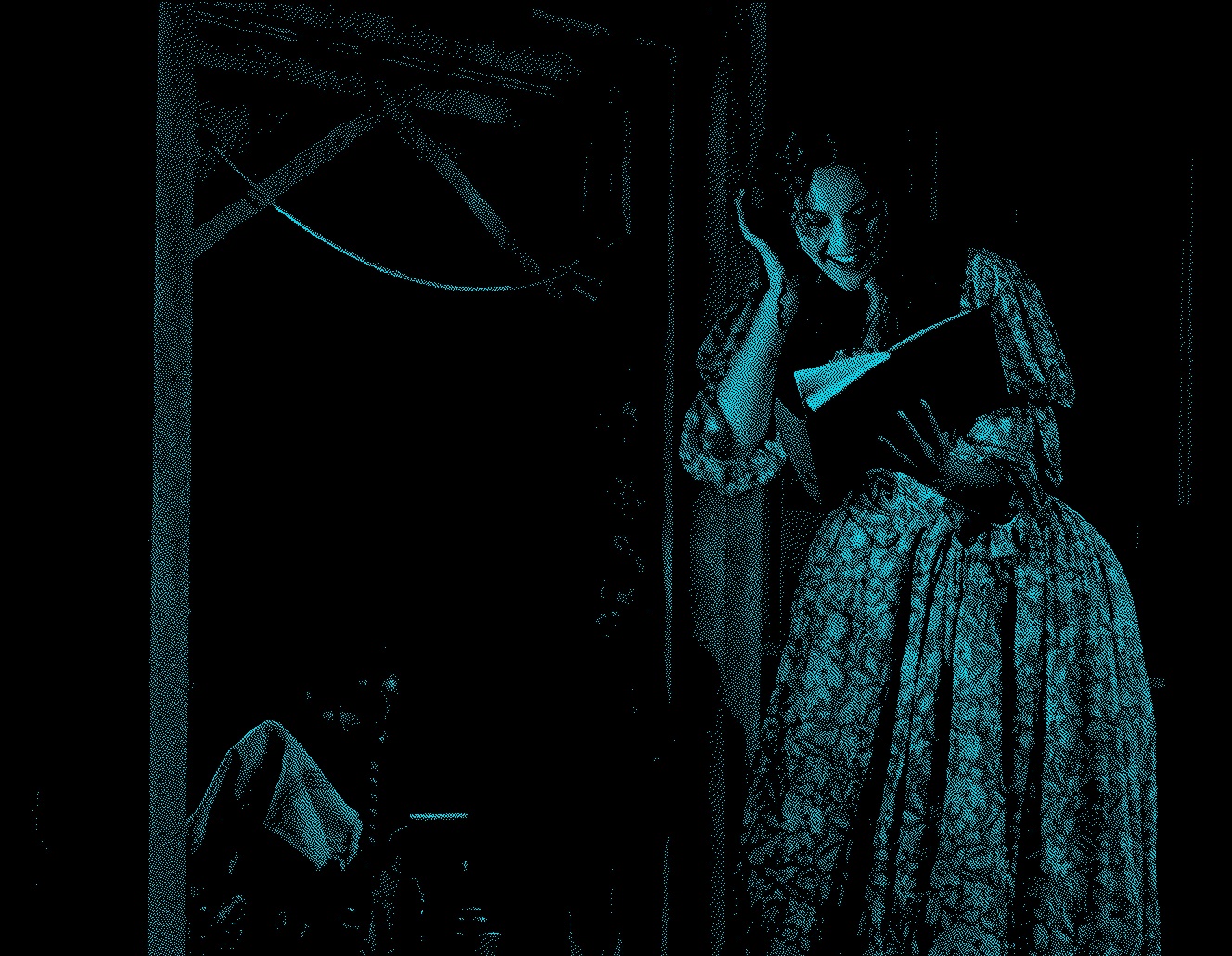
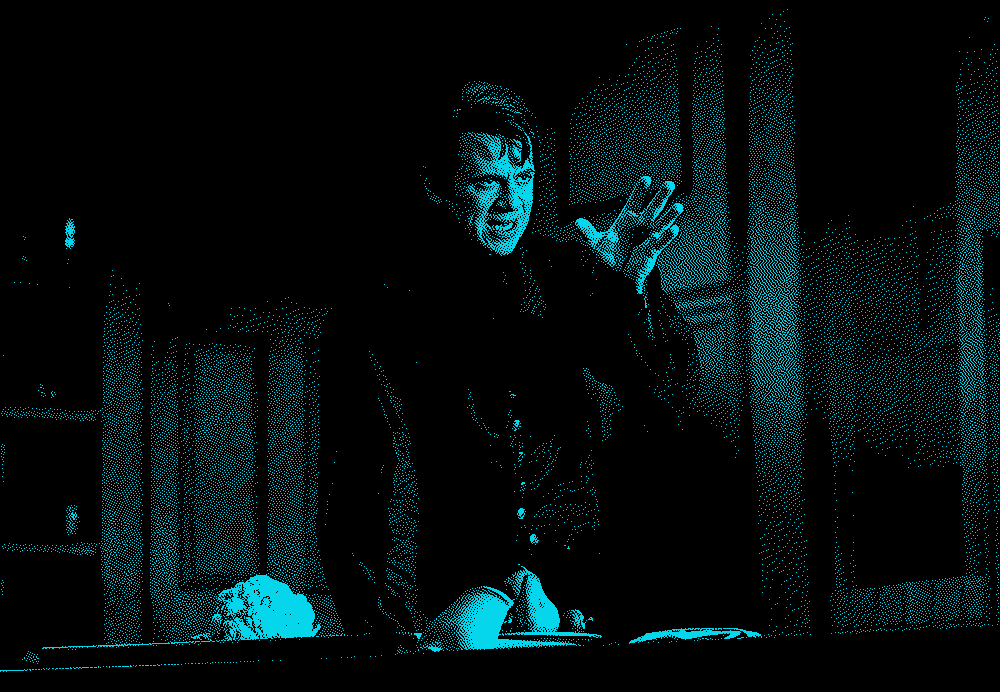
<p>Emily Burns’s <em>Frankenstein</em> revolves primarily around the dialogue of Elizabeth Lavenza (Rebecca S’manga Frank) and  Victor Frankenstein (Nick Westrate), with occasional appearances by Justine Moritz (Anna Takayo), the Creature (Lucas Iverson/José Espinoza), and young Elizabeth (Monroe E. Barnes/Mila Weir). The supporting actors also portray Burns’s original creations: characters appended to Mary Shelley’s original cast as the play’s plot diverges from the source material.</p>

<blockquote>
  <p>“<em>This</em> play is its own creature, drawn from the constituent parts of the novel, but reframed through a contemporary psychology.” Emily Burns, director’s note</p>
</blockquote>

<p>Mary Shelley’s <em>Frankenstein</em>, too, came to life through de- and re-composition. While scholars can trace multiple drafts, revisions, and variations of Mary Shelley’s <em>Frankenstein</em> manuscript, readers today will have encountered either Shelley’s original 1818 publication or her 1831 revised edition, the latter being the more sensational of the two that is now most referenced by schools and pop culture. Shelley’s revisions in 1831 are seemingly minor — a line here, a scene there — but overall present a different picture of Victor Frankenstein than the original. In 1831, he is a man doomed by fate, rather than the father of his own decisions. These small changes strip Victor of the agency he had in the 1818 manuscript. Likewise, while Act 1 of Emily Burns’s adaptation remains loyal to Shelley’s original plot, her small alterations in the timeline of the story yield more agency to her characters and more intimate insight onto their motives.</p>

<p>Act I of Burns’s <em>Frankenstein</em> bounces around the first six years of Mary Shelley’s novel, from the death of Caroline Frankenstein to Victor’s departure for Ingolstadt to William’s death and Justine’s conviction. The smaller cast of predominantly women enables faithful adherence to the beginning of the novel while enabling Burns to explore these events from the domestic sphere: we never see William, or even the Creature, before intermission. While we feel their presence in the plot, the dialogue primarily takes place within the walls of the house of Frankenstein — within Elizabeth’s circle of command.</p>

<p>Right away, I was struck by the contemporary feel of the dialogue. Burns made it clear that we were not in for a rigid Regency reenactment but a modern interpretation of the original plot. Victor and Elizabeth’s banter, and particularly Elizabeth’s audacious back-talk, characterized the leads as twenty-somethings in the twenty-first century, even though the costumes reflect Mary Shelley’s historical context. At one point, while scheming how to exonerate Justine, Victor calls for silence while he “cooks.” But then Elizabeth reminds me we are in the 18th century — or at least, I think she does. In hindsight, Elizabeth lamenting her unmarried, unmothered status is both a “product of its time” and a familiar crisis to many women in their twenties and thirties today: the feeling of <em>what am I doing with my life?!</em> as our friends begin to wed and have children.</p>

<p><img src="/assets/images/2025-07-02/frankenstein2_dithered.jpg" alt="Rebecca S'manga Frank as Elizabeth Lavenza reads Victor Frankenstein's journal" /></p>

<p>I imagine that Act II is the narrative that perhaps Mary Shelley would have written if she lived in the 21st century. When she first published <em>Frankenstein</em>, she wrote anonymously, likely to avoid controversy over the thought of a young woman writing something so horrific. Yet rivaling the horror of galvanism was the taboo of pregnancy  —  the bood, the gore, the implication that two people had sex — during the Victorian era. Mary Shelley had to disguise her commentary on parenthood behind a metaphor of monstrosity in order to be published at all. The idea that the novel was a metaphor for pregnancy did not occur to scholars until the 1970s, and to most people today, <em>Frankenstein</em> is a story about a monster. But Burns’s argument in the adaptation is clearly conveyed in contemporary dialogue, through the classic conversation that tears couples apart to this day: to have, or not to have, children.</p>

<p>Someone on Reddit  —  ah, yes, the pinnacle of relationship advice — wrote that two people dating who disagree on whether or not to have children are as fundamentally incompatible as a straight woman dating a gay man. In this way, Victor and Elizabeth are fundamentally incompatible yet no different from every other couple in r/relationships that have this same problem. But Burns, with the power of a contemporary audience, can tell this story in a way Mary Shelley could not. During the time of the original Victor and Elizabeth, a married couple was expected to bear children. When Victor’s father Alphonse expresses his aniticipation that “new and dear objects of care will be born”, Mary Shelley’s Victor is helpless to say otherwise; on stage with Emily Burns’s iteration of the characters, they are finally able to discuss this out loud.</p>

<p><img src="/assets/images/2025-07-02/dither_it_frankenstein3.jpg" alt="Nick Westrate's Victor Frankenstein gestures angrily over a bowl of fruit" /></p>

<p>I’m always reading about Millennials and Gen Z today deciding not to have children: because they do not want to force a child to live through the climate crisis, because they do not want to pass along their intergenerational trauma, because they simply don’t want the responsibility and in this day and age they can make that choice. The Creature himself is a metaphor for a child unwanted, which movie adaptations from Universal’s to Kenneth Branaugh’s introduce early on to win the viewer’s sympathy. In these films and in the original novel, Victor is the main character. But in Burns’s <em>Frankenstein</em>, the audience meets the Creature at the same time the original Elizabeth does — at the very end. This Creature subverted the blueprint of his character, as Burns rewrites his narrative to give him the parental maturity that Victor Frankenstein never had. Unlike previous iterations of his character, the Creature refuses to use Victor’s negligence to justify his own violence. Instead, he asserts that we can choose not to become our parents. His character proves to be the most virtuous of the play; his fate the most optimistic re-imagining of Shelley’s original ending that I’ve ever seen.</p>

<p>If we imagine a story as a length of twine, composed of distict yet interwoven threads, I believe a good adaptation takes one of those threads and reinforces it through the adapter’s eyes. Burns’s adaptation isolates the thread of parenthood and translates it from Shelley’s florid prose to modern dialogue, highlighting Victor and Elizabeth’s plight as one that haunts couples and families today. I am hesitant to invoke the marketing label of “feminist re-telling” — while Emily Burns writes three waves of feminism ahead of Mary Shelley, and can assume that her audience has the vocabulary (and Internet slang) to catch up, I don’t see the play’s politics as inherently an “update” from the original. In either iteration, Victor and Elizabeth were doomed by neither monstrosity nor by mad science, but rather by their inherent incompatibility and inability to communicate with each other. If that wasn’t clear after reading Shelley’s manuscript, it should certainly be after watching Burns’s play.</p>

<p><small>All images in this post courtesy of the Shakespeare Theatre Company.</small></p>

<hr />

<p><small><a href="https://www.shakespearetheatre.org/events/frankenstein-24-25/" target="_blank"><em>Frankenstein</em> (dir. Emily Burns)</a> premiered at the Shakespeare Theatre Company’s Klein Theatre on May 27, 2025 and ran until June 29. Note for theatergoers below the age of 35! Shakespeare Theater Company offers $35 tickets to all productions for under-35s (IDs are checked at the venue), <a href="https://www.shakespearetheatre.org/tickets-and-events/special-offers/under-35/" target="_blank">details here</a> as well as “Young Prose Nights” for select productions, which offers free drinks and a reception at the end of the show.</small></p>]]></content><author><name></name></author><category term="1000-1500" /><category term="words," /><category term="review," /><category term="theater" /><summary type="html"><![CDATA[Frankenstein dir. Emily Burns Date seen: June 6, 2025 Date reviewed: June-July 2025 (Yes, I am a procrastinator) SPOILERS for Mary Shelley’s Frankenstein ahead. The two or three people who read this blog will probably know that outside of my new-media-art-posting, I spent a good part of this year hyperfixating on Mary Shelley’s Frankenstein. When I found out that the Shakespeare Theater Company in D.C. would be putting on a production of the gothic classic, I booked tickets right then and there. Emily Burns’s stage adaptation has now completed its premiere run, and I had the pleasure of watching it on June 6 as part of the theater’s Young Prose Night. Overall, I was deeply impressed by the production quality, the set and sound design, and the interplay between the script and Shelley’s original prose. Emily Burns’s Frankenstein revolves primarily around the dialogue of Elizabeth Lavenza (Rebecca S’manga Frank) and Victor Frankenstein (Nick Westrate), with occasional appearances by Justine Moritz (Anna Takayo), the Creature (Lucas Iverson/José Espinoza), and young Elizabeth (Monroe E. Barnes/Mila Weir). The supporting actors also portray Burns’s original creations: characters appended to Mary Shelley’s original cast as the play’s plot diverges from the source material. “This play is its own creature, drawn from the constituent parts of the novel, but reframed through a contemporary psychology.” Emily Burns, director’s note Mary Shelley’s Frankenstein, too, came to life through de- and re-composition. While scholars can trace multiple drafts, revisions, and variations of Mary Shelley’s Frankenstein manuscript, readers today will have encountered either Shelley’s original 1818 publication or her 1831 revised edition, the latter being the more sensational of the two that is now most referenced by schools and pop culture. Shelley’s revisions in 1831 are seemingly minor — a line here, a scene there — but overall present a different picture of Victor Frankenstein than the original. In 1831, he is a man doomed by fate, rather than the father of his own decisions. These small changes strip Victor of the agency he had in the 1818 manuscript. Likewise, while Act 1 of Emily Burns’s adaptation remains loyal to Shelley’s original plot, her small alterations in the timeline of the story yield more agency to her characters and more intimate insight onto their motives. Act I of Burns’s Frankenstein bounces around the first six years of Mary Shelley’s novel, from the death of Caroline Frankenstein to Victor’s departure for Ingolstadt to William’s death and Justine’s conviction. The smaller cast of predominantly women enables faithful adherence to the beginning of the novel while enabling Burns to explore these events from the domestic sphere: we never see William, or even the Creature, before intermission. While we feel their presence in the plot, the dialogue primarily takes place within the walls of the house of Frankenstein — within Elizabeth’s circle of command. Right away, I was struck by the contemporary feel of the dialogue. Burns made it clear that we were not in for a rigid Regency reenactment but a modern interpretation of the original plot. Victor and Elizabeth’s banter, and particularly Elizabeth’s audacious back-talk, characterized the leads as twenty-somethings in the twenty-first century, even though the costumes reflect Mary Shelley’s historical context. At one point, while scheming how to exonerate Justine, Victor calls for silence while he “cooks.” But then Elizabeth reminds me we are in the 18th century — or at least, I think she does. In hindsight, Elizabeth lamenting her unmarried, unmothered status is both a “product of its time” and a familiar crisis to many women in their twenties and thirties today: the feeling of what am I doing with my life?! as our friends begin to wed and have children. I imagine that Act II is the narrative that perhaps Mary Shelley would have written if she lived in the 21st century. When she first published Frankenstein, she wrote anonymously, likely to avoid controversy over the thought of a young woman writing something so horrific. Yet rivaling the horror of galvanism was the taboo of pregnancy — the bood, the gore, the implication that two people had sex — during the Victorian era. Mary Shelley had to disguise her commentary on parenthood behind a metaphor of monstrosity in order to be published at all. The idea that the novel was a metaphor for pregnancy did not occur to scholars until the 1970s, and to most people today, Frankenstein is a story about a monster. But Burns’s argument in the adaptation is clearly conveyed in contemporary dialogue, through the classic conversation that tears couples apart to this day: to have, or not to have, children. Someone on Reddit — ah, yes, the pinnacle of relationship advice — wrote that two people dating who disagree on whether or not to have children are as fundamentally incompatible as a straight woman dating a gay man. In this way, Victor and Elizabeth are fundamentally incompatible yet no different from every other couple in r/relationships that have this same problem. But Burns, with the power of a contemporary audience, can tell this story in a way Mary Shelley could not. During the time of the original Victor and Elizabeth, a married couple was expected to bear children. When Victor’s father Alphonse expresses his aniticipation that “new and dear objects of care will be born”, Mary Shelley’s Victor is helpless to say otherwise; on stage with Emily Burns’s iteration of the characters, they are finally able to discuss this out loud. I’m always reading about Millennials and Gen Z today deciding not to have children: because they do not want to force a child to live through the climate crisis, because they do not want to pass along their intergenerational trauma, because they simply don’t want the responsibility and in this day and age they can make that choice. The Creature himself is a metaphor for a child unwanted, which movie adaptations from Universal’s to Kenneth Branaugh’s introduce early on to win the viewer’s sympathy. In these films and in the original novel, Victor is the main character. But in Burns’s Frankenstein, the audience meets the Creature at the same time the original Elizabeth does — at the very end. This Creature subverted the blueprint of his character, as Burns rewrites his narrative to give him the parental maturity that Victor Frankenstein never had. Unlike previous iterations of his character, the Creature refuses to use Victor’s negligence to justify his own violence. Instead, he asserts that we can choose not to become our parents. His character proves to be the most virtuous of the play; his fate the most optimistic re-imagining of Shelley’s original ending that I’ve ever seen. If we imagine a story as a length of twine, composed of distict yet interwoven threads, I believe a good adaptation takes one of those threads and reinforces it through the adapter’s eyes. Burns’s adaptation isolates the thread of parenthood and translates it from Shelley’s florid prose to modern dialogue, highlighting Victor and Elizabeth’s plight as one that haunts couples and families today. I am hesitant to invoke the marketing label of “feminist re-telling” — while Emily Burns writes three waves of feminism ahead of Mary Shelley, and can assume that her audience has the vocabulary (and Internet slang) to catch up, I don’t see the play’s politics as inherently an “update” from the original. In either iteration, Victor and Elizabeth were doomed by neither monstrosity nor by mad science, but rather by their inherent incompatibility and inability to communicate with each other. If that wasn’t clear after reading Shelley’s manuscript, it should certainly be after watching Burns’s play. All images in this post courtesy of the Shakespeare Theatre Company. Frankenstein (dir. Emily Burns) premiered at the Shakespeare Theatre Company’s Klein Theatre on May 27, 2025 and ran until June 29. Note for theatergoers below the age of 35! Shakespeare Theater Company offers $35 tickets to all productions for under-35s (IDs are checked at the venue), details here as well as “Young Prose Nights” for select productions, which offers free drinks and a reception at the end of the show.]]></summary></entry><entry><title type="html">AI, Gunpowder, and Cai Guo-Qiang’s “Interspecies Love Letter”</title><link href="https://seenby.urlocalcyb.org/2025/04/16/cai.html" rel="alternate" type="text/html" title="AI, Gunpowder, and Cai Guo-Qiang’s “Interspecies Love Letter”" /><published>2025-04-16T00:00:00+00:00</published><updated>2025-04-16T00:00:00+00:00</updated><id>https://seenby.urlocalcyb.org/2025/04/16/cai</id><content type="html" xml:base="https://seenby.urlocalcyb.org/2025/04/16/cai.html"><![CDATA[<p><strong><em>Interspecies Love Letter</em> by Cai Guo-Qiang and <em>cAI</em></strong><br />
<small>Date visited: April 13, 2025</small><br />
<small>Date reviewed: April 16, 2025</small></p>

<p>From March 28 through April 13 of this year, The Kennedy Center had on display a series of installations under the theme “Earth to Space,” including an exhibit contributed by faculty and students from my alma mater. I came initially to check out <a href="https://www.kennedy-center.org/whats-on/explore-by-genre/exhibits/2024-2025/wave-from-space-to-ocean/">my former professors’ and classmates’ work</a>, but the interactivity wasn’t working when I arrived. (That’s what you get for showing up on the last Sunday!) I did, however, check out the installation <em>Interspecies Love Letter</em> by Cai Guo-Qiang and came away with much to chew on regarding its use of AI.</p>

<p>Note that I approach AI-facilitated artworks with immediate scrutiny. It isn’t just the OpenAI products that have cheapened the meaning of artificial intelligence; it’s also that I spent the last four years exposing myself to so much technologically-mediated art that I have a stupidly high threshold as to what I’d consider innovative. Naturally, I came to this exhibit with the impulse to critique. I entered the space expecting a screen- or projection-oriented installation just like the one that my department worked on, but instead was surprised by its materiality.</p>

<p><img src="/assets/images/2025-4-16/interspecies_love_letter.jpg" alt="alt text" />
<small>The titular piece of the installation, “Interspecies Love Letter,” gunpowder on canvas. Image courtesy of the artist.</small></p>
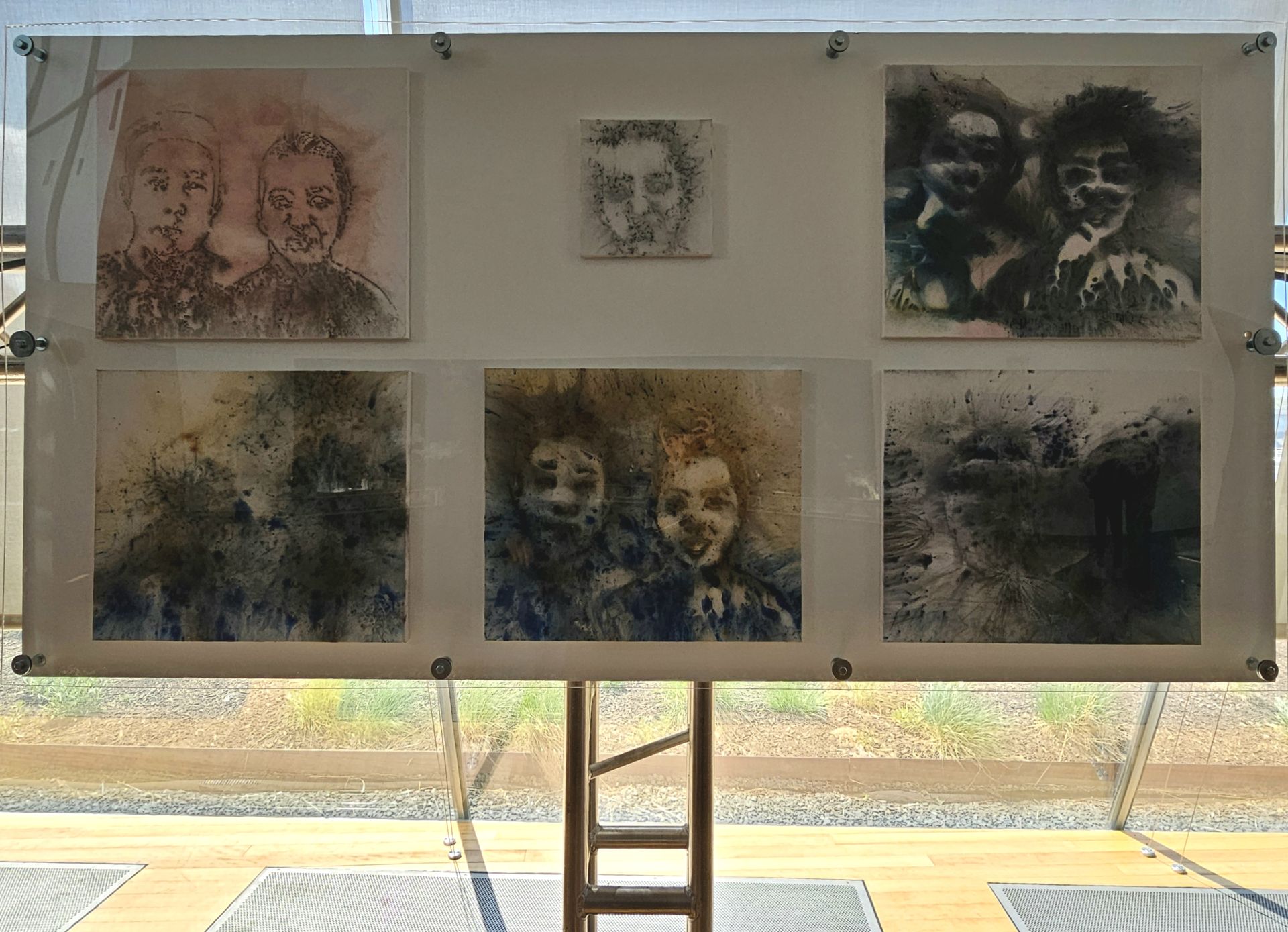
<p>Guo-Qiang presents <em>Interspecies Love Letter</em> as a collaboration between the artist himself and <em>cAI</em> (pronounced “AI Cai”), a custom AI model developed in the artist’s own studio using the artist’s artwork and archives. This transparency in the exhibition material verifies, in my eyes, the integrity of the model, distinguishing it from the resource-guzzling corporate products that plagiarize human artists en masse. I am more receptive to applications like <em>cAI</em>, where the model is trained on a private dataset which the developer rightfully owns. In this case I consider the AI curatorial as well as a generative tool.</p>

<p>The installation itself featured several projects done in collaboration with <em>cAI</em>, including a print manifesto, a series of portraits and interviews emulating historical figures, and several gunpowder paintings. Pictured above, the title painting <em>Interspecies Love Letter</em> was a vast mural that took up an entire wall. The focus of the room was a large sculptural installation in the shape of an alien spacecraft, with embedded screens that ran some sort of interactive piece inviting participants to write love letters to the alien species. Unfortunately this part of the exhibition was not working while I was there.</p>

<p>The first part of the installation that I approached was <em>cAI</em>’s manifesto. While the prose itself was lyrically composed, already surpassing the generic outputs of corporate AI, I found the narrative of the installation all too familiar. The trope of human vs. alien and man vs. machination are well-worn in science fiction tradition, and in cAI’s manifesto I recognized the voices of Frankenstein’s monster and Asimov’s rules of robotics. What I <em>did</em> find more novel about this installation was its incorporation of documentation and process.</p>

<p><img src="/assets/images/2025-4-16/grandparents.jpg" alt="alt text" />
<small>Photo taken by the reviewer of wedding portraits created by <em>cAI</em>.</small></p>

<p>Take this wall of the installation, covered with gunpowder-on-canvas paintings of the artist’s grandparents. According to the exhibition materials, this series was created for the artist’s grandmother, who lamented that she didn’t have a photo of her wedding day. <em>cAI</em> stitched together two separate photographs of Guo-Qiang’s grandparents to produce an artificial photo. The result isn’t remarkable on its own — corporate AI products can do this as well — it’s these gunpowder paintings, these physical realizations of the machine’s iterations, that make this experiment worthy of exhibition.</p>

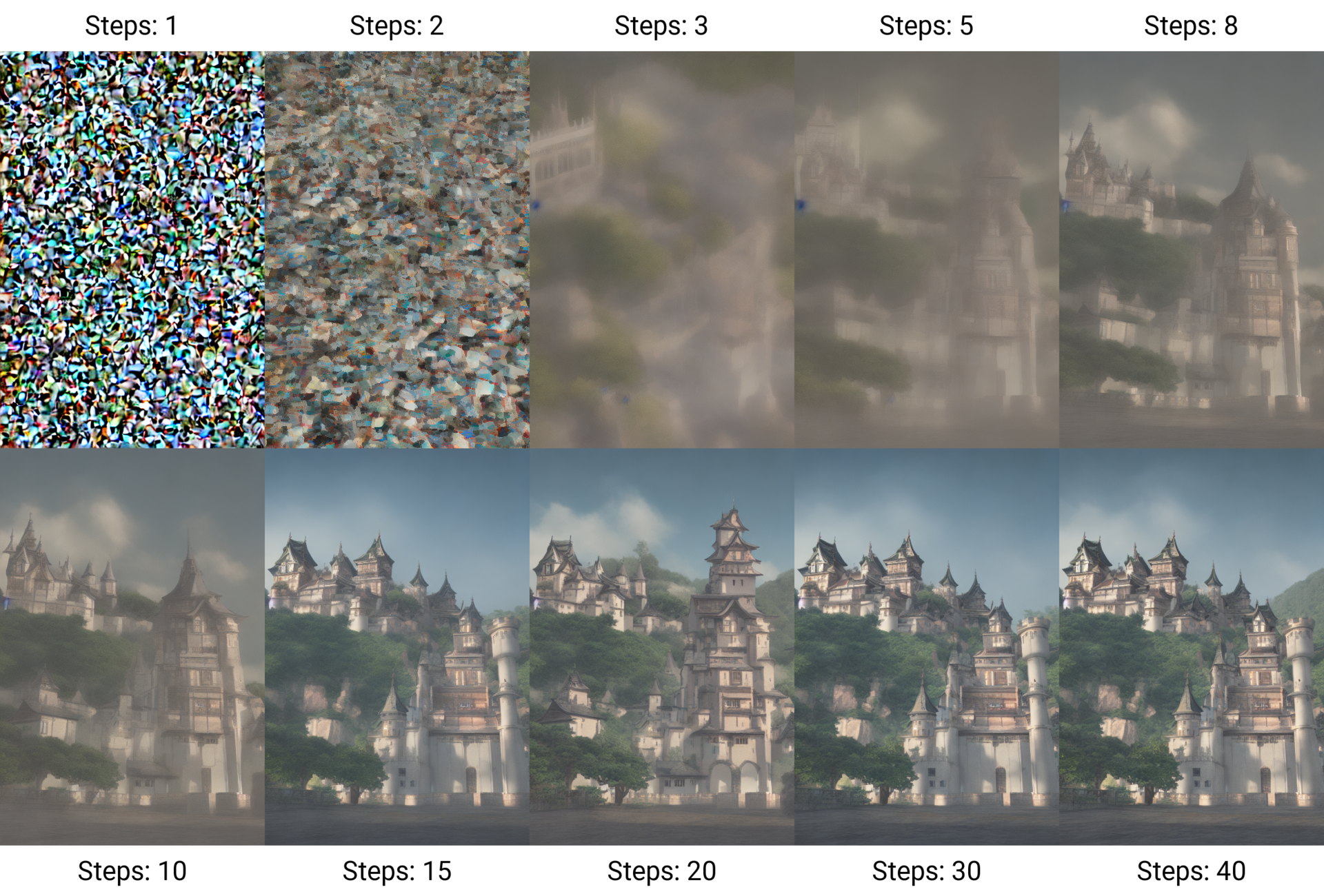
<p>Machine learning algorithms such as those that power DALL-E and Stable Diffusion run in cycles, what computer scientists call “batches” or “epochs,” that apply mathematical transformations on vast arrays of data in order to get it closer to a desired result. The varying clarity in Guo-Qiang’s gunpowder paintings remind me of this iterative process — it is as if the artist is simulating each batch run by the neural network.</p>

<p><img src="/assets/images/2025-4-16/stable-diffusion-example.png" alt="alt text" />
<small>How Stable Diffusion generates images. Benlisquare, CC BY-SA 4.0 <a href="https://creativecommons.org/licenses/by-sa/4.0">https://creativecommons.org/licenses/by-sa/4.0</a>, via Wikimedia Commons</small></p>

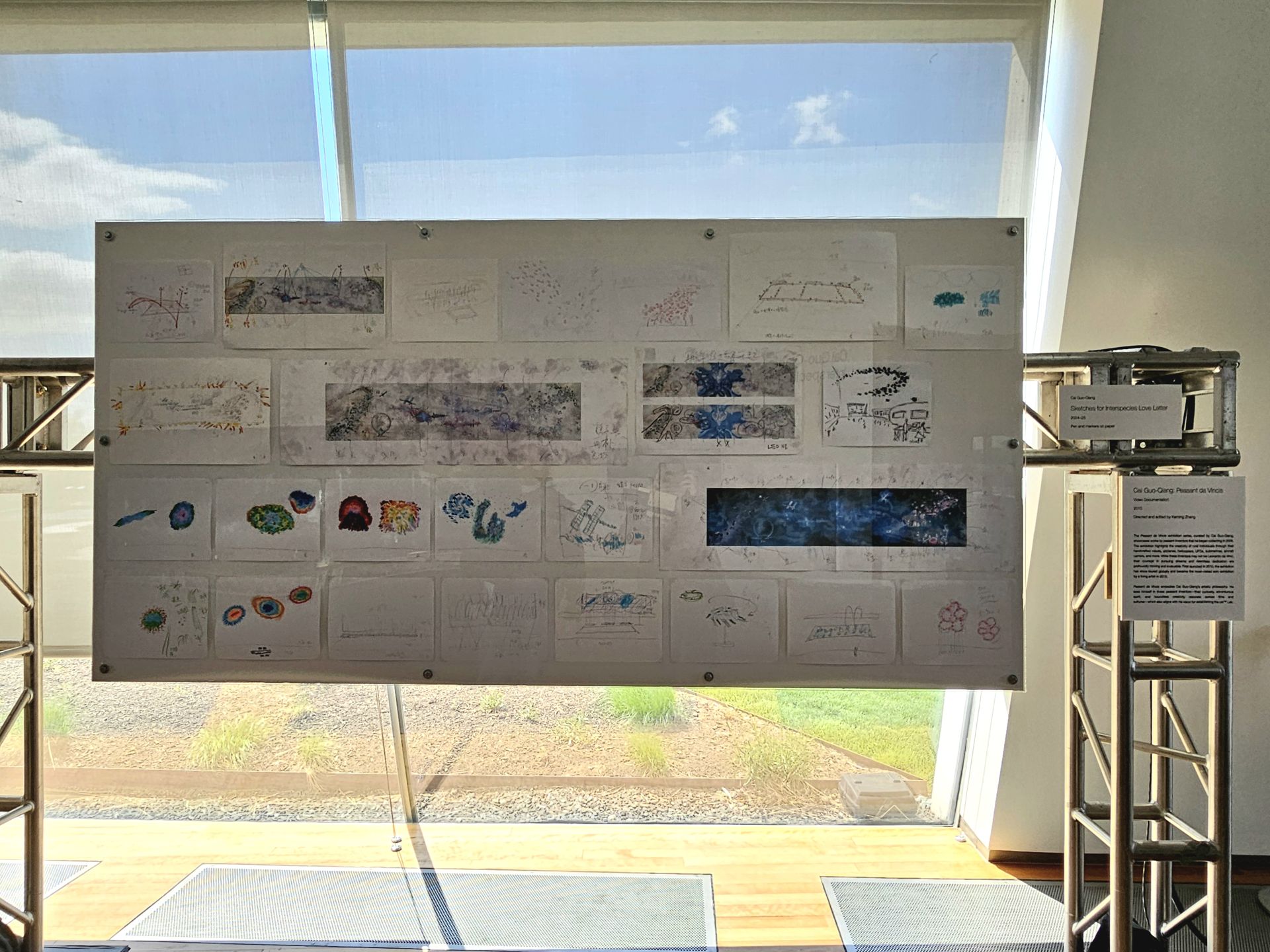
<p>Take, also, the more literal exhibitions of the artist’s process featured in the installation space: a wall of loose sketches and chicken-scratch annotations; documentation footage showing studio assistants constructing the massive title painting. What are we to make of this? AI is a medium that does not show its work. Mathematically, it is a black box that even specialists struggle to understand; to the everyday user, it is something that happens magically with the click of a button. So the inclusion of documentation in <em>Interspecies Love Letter</em> highlights human labor and frames the <em>humanity</em> of this collabration with the machine.</p>

<p>But despite the clear emphasis on the human hand, the artist insists on listing <em>cAI</em> as collaborator. Unlike the AI “artists” who take the output of the machine and call it their own, Guo-Qiang appears to have taken the output of human labor to pass off as the machine’s — an intentional act of humility, of deference, that subverts the selfish plagiarism of the DALL-E user. Here, the machine takes credit for the human’s work, instead of the other way around. In that sense, I wonder if the AI is to be interpreted as a kind of performance or an alter-ego. After all, the AI shares the artist’s name.</p>

<p><img src="/assets/images/2025-4-16/sketches.jpg" alt="alt text" />
<small>Photo taken by the reviewer of the wall of sketches for <em>Interspecies Love Letter</em>.</small></p>

<p>While writing this review, I find myself wishing I took more pictures of the exhibit. The gunpowder paintings reminded me of the work of <a href="https://www.stephaniemercedes.com/about">Stephanie Mercedes</a> whose molten bullet sculptures I have seen in exhibition at my alma mater. I wasn’t sure if this medium was part of a historical legacy I am unfamiliar with, or if it was unique to the artist, but when I Google “gunpowder painting,” Cai Guo-Qiang’s name is the first that comes up. This medium is more novel to me than any any of the tech stuff: art done from the materials of imperial violence. Perhaps you can say the same about AI.</p>

<hr />

<p><small><em>Interspecies Love Letter</em> was on display from March 28 to April 13 at The Kennedy Center as part of its <a href="https://www.kennedy-center.org/whats-on/festivals-series/earth-to-space/">EARTH to SPACE</a> festival. View the artist’s documentation of this exhibit <a href="https://caiguoqiang.com/projects/projects-2025/interspecies-love-letter/">here</a>.</small></p>

<p><small>I cannot discuss The Kennedy Center without also mentioning the apalling e-mail conversation that local artist Yasmin Williams had with its Trump-appointed director Richard Grenell, which she has published <a href="https://www.instagram.com/p/DIO5-RIunqI/">here</a>. Any patron of The Kennedy Center (and in general, of the arts in Washington, D.C.) should recognize Grenell’s behavior as the antithesis of creative practice, professionalism, and community.</small></p>]]></content><author><name></name></author><category term="500-1000" /><category term="words," /><category term="review," /><category term="ai," /><category term="installation" /><summary type="html"><![CDATA[Interspecies Love Letter by Cai Guo-Qiang and cAI Date visited: April 13, 2025 Date reviewed: April 16, 2025 From March 28 through April 13 of this year, The Kennedy Center had on display a series of installations under the theme “Earth to Space,” including an exhibit contributed by faculty and students from my alma mater. I came initially to check out my former professors’ and classmates’ work, but the interactivity wasn’t working when I arrived. (That’s what you get for showing up on the last Sunday!) I did, however, check out the installation Interspecies Love Letter by Cai Guo-Qiang and came away with much to chew on regarding its use of AI. Note that I approach AI-facilitated artworks with immediate scrutiny. It isn’t just the OpenAI products that have cheapened the meaning of artificial intelligence; it’s also that I spent the last four years exposing myself to so much technologically-mediated art that I have a stupidly high threshold as to what I’d consider innovative. Naturally, I came to this exhibit with the impulse to critique. I entered the space expecting a screen- or projection-oriented installation just like the one that my department worked on, but instead was surprised by its materiality. The titular piece of the installation, “Interspecies Love Letter,” gunpowder on canvas. Image courtesy of the artist. Guo-Qiang presents Interspecies Love Letter as a collaboration between the artist himself and cAI (pronounced “AI Cai”), a custom AI model developed in the artist’s own studio using the artist’s artwork and archives. This transparency in the exhibition material verifies, in my eyes, the integrity of the model, distinguishing it from the resource-guzzling corporate products that plagiarize human artists en masse. I am more receptive to applications like cAI, where the model is trained on a private dataset which the developer rightfully owns. In this case I consider the AI curatorial as well as a generative tool. The installation itself featured several projects done in collaboration with cAI, including a print manifesto, a series of portraits and interviews emulating historical figures, and several gunpowder paintings. Pictured above, the title painting Interspecies Love Letter was a vast mural that took up an entire wall. The focus of the room was a large sculptural installation in the shape of an alien spacecraft, with embedded screens that ran some sort of interactive piece inviting participants to write love letters to the alien species. Unfortunately this part of the exhibition was not working while I was there. The first part of the installation that I approached was cAI’s manifesto. While the prose itself was lyrically composed, already surpassing the generic outputs of corporate AI, I found the narrative of the installation all too familiar. The trope of human vs. alien and man vs. machination are well-worn in science fiction tradition, and in cAI’s manifesto I recognized the voices of Frankenstein’s monster and Asimov’s rules of robotics. What I did find more novel about this installation was its incorporation of documentation and process. Photo taken by the reviewer of wedding portraits created by cAI. Take this wall of the installation, covered with gunpowder-on-canvas paintings of the artist’s grandparents. According to the exhibition materials, this series was created for the artist’s grandmother, who lamented that she didn’t have a photo of her wedding day. cAI stitched together two separate photographs of Guo-Qiang’s grandparents to produce an artificial photo. The result isn’t remarkable on its own — corporate AI products can do this as well — it’s these gunpowder paintings, these physical realizations of the machine’s iterations, that make this experiment worthy of exhibition. Machine learning algorithms such as those that power DALL-E and Stable Diffusion run in cycles, what computer scientists call “batches” or “epochs,” that apply mathematical transformations on vast arrays of data in order to get it closer to a desired result. The varying clarity in Guo-Qiang’s gunpowder paintings remind me of this iterative process — it is as if the artist is simulating each batch run by the neural network. How Stable Diffusion generates images. Benlisquare, CC BY-SA 4.0 https://creativecommons.org/licenses/by-sa/4.0, via Wikimedia Commons Take, also, the more literal exhibitions of the artist’s process featured in the installation space: a wall of loose sketches and chicken-scratch annotations; documentation footage showing studio assistants constructing the massive title painting. What are we to make of this? AI is a medium that does not show its work. Mathematically, it is a black box that even specialists struggle to understand; to the everyday user, it is something that happens magically with the click of a button. So the inclusion of documentation in Interspecies Love Letter highlights human labor and frames the humanity of this collabration with the machine. But despite the clear emphasis on the human hand, the artist insists on listing cAI as collaborator. Unlike the AI “artists” who take the output of the machine and call it their own, Guo-Qiang appears to have taken the output of human labor to pass off as the machine’s — an intentional act of humility, of deference, that subverts the selfish plagiarism of the DALL-E user. Here, the machine takes credit for the human’s work, instead of the other way around. In that sense, I wonder if the AI is to be interpreted as a kind of performance or an alter-ego. After all, the AI shares the artist’s name. Photo taken by the reviewer of the wall of sketches for Interspecies Love Letter. While writing this review, I find myself wishing I took more pictures of the exhibit. The gunpowder paintings reminded me of the work of Stephanie Mercedes whose molten bullet sculptures I have seen in exhibition at my alma mater. I wasn’t sure if this medium was part of a historical legacy I am unfamiliar with, or if it was unique to the artist, but when I Google “gunpowder painting,” Cai Guo-Qiang’s name is the first that comes up. This medium is more novel to me than any any of the tech stuff: art done from the materials of imperial violence. Perhaps you can say the same about AI. Interspecies Love Letter was on display from March 28 to April 13 at The Kennedy Center as part of its EARTH to SPACE festival. View the artist’s documentation of this exhibit here. I cannot discuss The Kennedy Center without also mentioning the apalling e-mail conversation that local artist Yasmin Williams had with its Trump-appointed director Richard Grenell, which she has published here. Any patron of The Kennedy Center (and in general, of the arts in Washington, D.C.) should recognize Grenell’s behavior as the antithesis of creative practice, professionalism, and community.]]></summary></entry><entry><title type="html">thoughts on the election as an aspiring GLAM worker</title><link href="https://seenby.urlocalcyb.org/2024/11/06/election-and-glam.html" rel="alternate" type="text/html" title="thoughts on the election as an aspiring GLAM worker" /><published>2024-11-06T00:00:00+00:00</published><updated>2024-11-06T00:00:00+00:00</updated><id>https://seenby.urlocalcyb.org/2024/11/06/election-and-glam</id><content type="html" xml:base="https://seenby.urlocalcyb.org/2024/11/06/election-and-glam.html"><![CDATA[<h3 id="or-im-just-saving-this-here-for-the-future-me-who-has-an-mlis-and-answers-to-things">or: i’m just saving this here for the future me who has an MLIS and answers to things</h3>
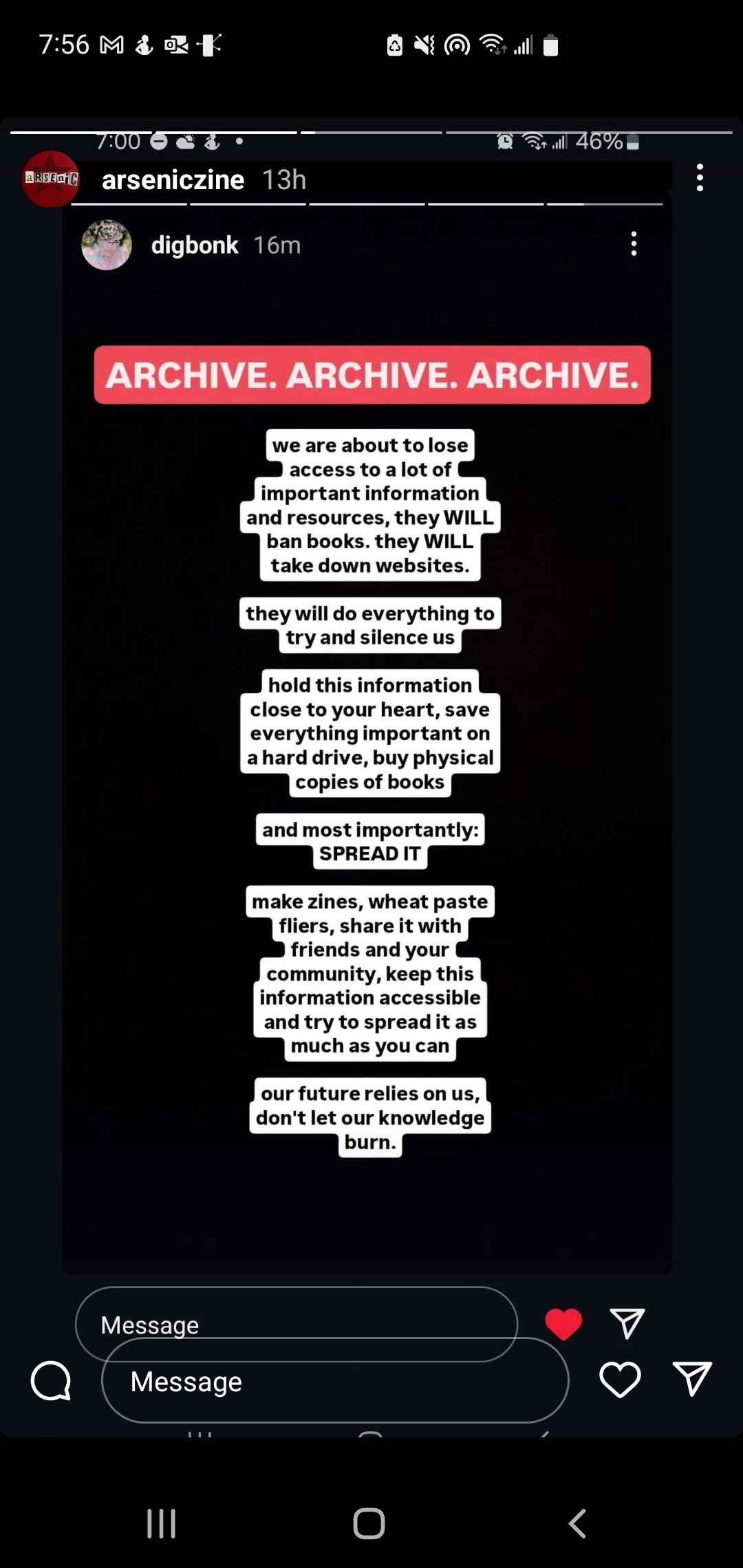
<p><img src="/assets/images/2024-11-6/screenshot.jpg" alt="Screenshot of an Instagram story that reads, &quot;We are about to lose access to a lot of important information and resources, they WILL ban books. they WILL take down websites. they will do everything to try and silence us. hold this information close to your heart, save everything important on a hard drive, buy physical copies of books, and most importantly SPREAD IT. make zines, wheat paste fliers, share it with your friends and your community, keep this information accessible and try to spread it as much as you can. your future relies on us. don't let our knowledge burn.&quot;" /></p>

<p>I spent my college years reckoning with the thought of working for an institution. No way, I thought in freshman year; a military brat for the first half of my life, and sick of the rigidity of academia, I intended to go straight into the private sector. Maybe leave school in three years.</p>

<p>But I grew up in the belly of the beast, the cradle of the Nation’s Capital, and as I continued my studies I fell in begrudging love with the knowledge institutions I was surrounded by. The belt of universities, the white marble libraries, the boxes of zines in manila envelopes collected and cherished by the citizen archivists and former punk rockers that found their call in this machine. I bought anarchist patches and chipped in to mutual aid and frequented DIY spaces that exist in the cracks of crumbling social infrastructure, yet decided to be part of the concrete.</p>

<p>But it wasn’t the National Archives or the Smithsonian Museums or the Library of Congress that made me see value in institution. It was the city pool on a hot summer day. As I walked to the lockers, past the splash of laughing families and the lap swimmers’ spirited gasps and the maze of kids at the hot dog stand, I thought about the structures that hold down our everyday and realized someone’s got to maintain it.</p>

<p>One man in the White House will not inherently corrupt the decent people working to maintain local infrastructure—the lifeguards, the librarians. But can I, in good conscience, shake hands with curators who bleach their history white for fear of Black and Brown blood? Can I yield to powerful men who snatch books from public shelves that teach children how to articulate their autonomy? What does it mean to be an archivist under the administration of a <em>felon</em> who smuggles papers meant for public record into the authority of his private home?</p>

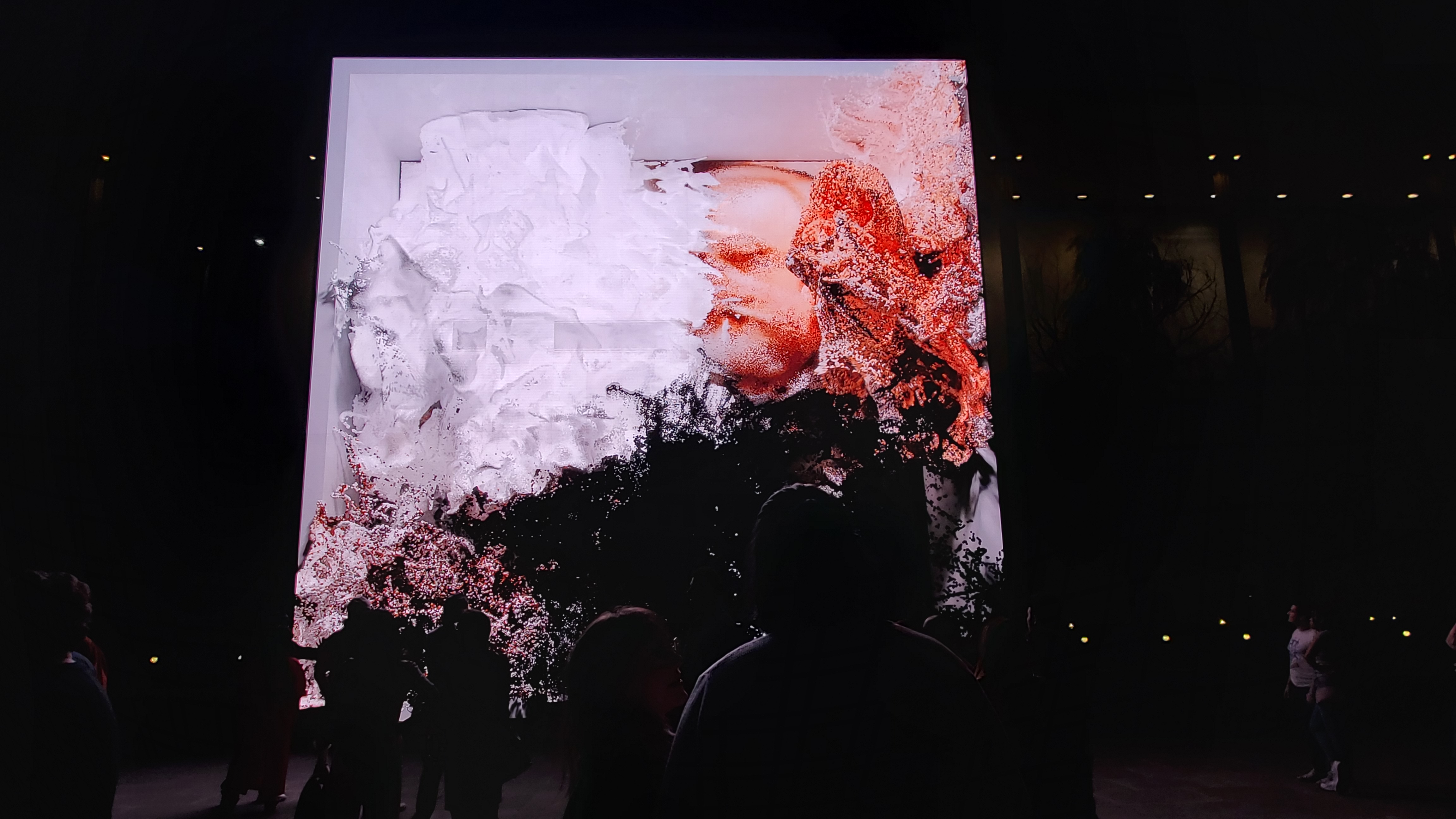
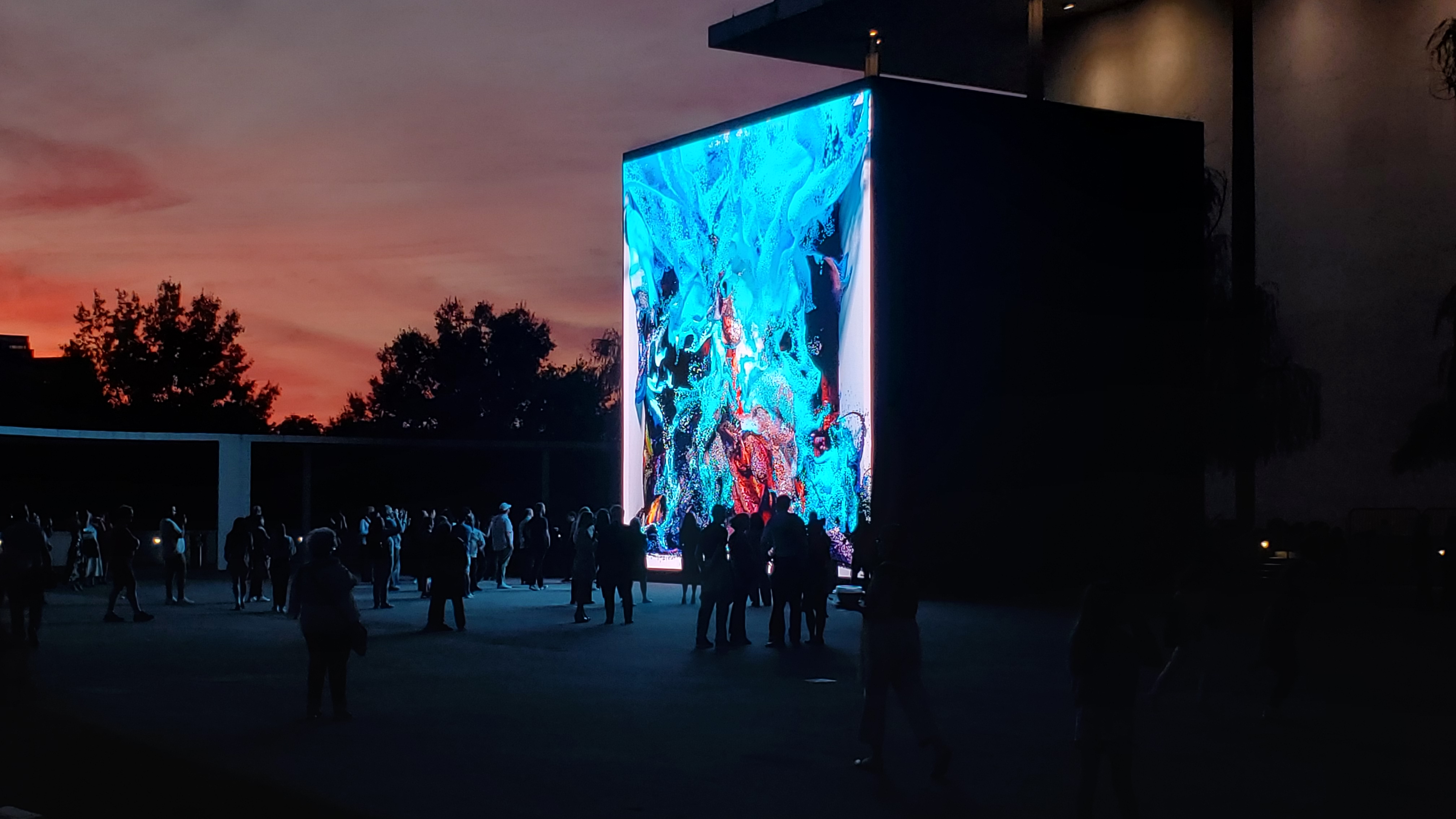
<p>“Nothing can get in the way of saving our democracy,” said President Biden when he left the race, “not even personal ambition.” It is indeed personal ambition, that I’ve been dazzled by prestigious institutions and their fancy machines. No, I am not abandoning my ambitions to be part of GLAM. No, of course I don’t believe that it will “save our democracy” to have one fewer librarian in the system. And no, just because the revulsion of the present moment manifested in this morning’s news, doesn’t mean that universities were not bombed, students were not tazed, libraries were not turned to rubble under the current administration. But with Trump’s re-election I am once again reminded that that to train for a career in an American institution is to prepare for a lifetime of fight.</p>]]></content><author><name></name></author><category term="i&apos;m" /><category term="just" /><category term="saving" /><category term="this" /><category term="here" /><category term="for" /><category term="the" /><category term="future" /><category term="when" /><category term="i&apos;ve" /><category term="got" /><category term="my" /><category term="degree" /><category term="and" /><category term="have" /><category term="answers" /><category term="to" /><category term="things" /><summary type="html"><![CDATA[or: i’m just saving this here for the future me who has an MLIS and answers to things]]></summary></entry><entry><title type="html">UR LOCAL HATER on Refik Anadol</title><link href="https://seenby.urlocalcyb.org/2024/09/19/dvorak-dreams.html" rel="alternate" type="text/html" title="UR LOCAL HATER on Refik Anadol" /><published>2024-09-19T00:00:00+00:00</published><updated>2024-09-19T00:00:00+00:00</updated><id>https://seenby.urlocalcyb.org/2024/09/19/dvorak-dreams</id><content type="html" xml:base="https://seenby.urlocalcyb.org/2024/09/19/dvorak-dreams.html"><![CDATA[<p>As UR LOCAL HATER of Refik Anadol’s work, when I heard he debuting an exhibit in D.C., I knew I had to see it for myself.</p>

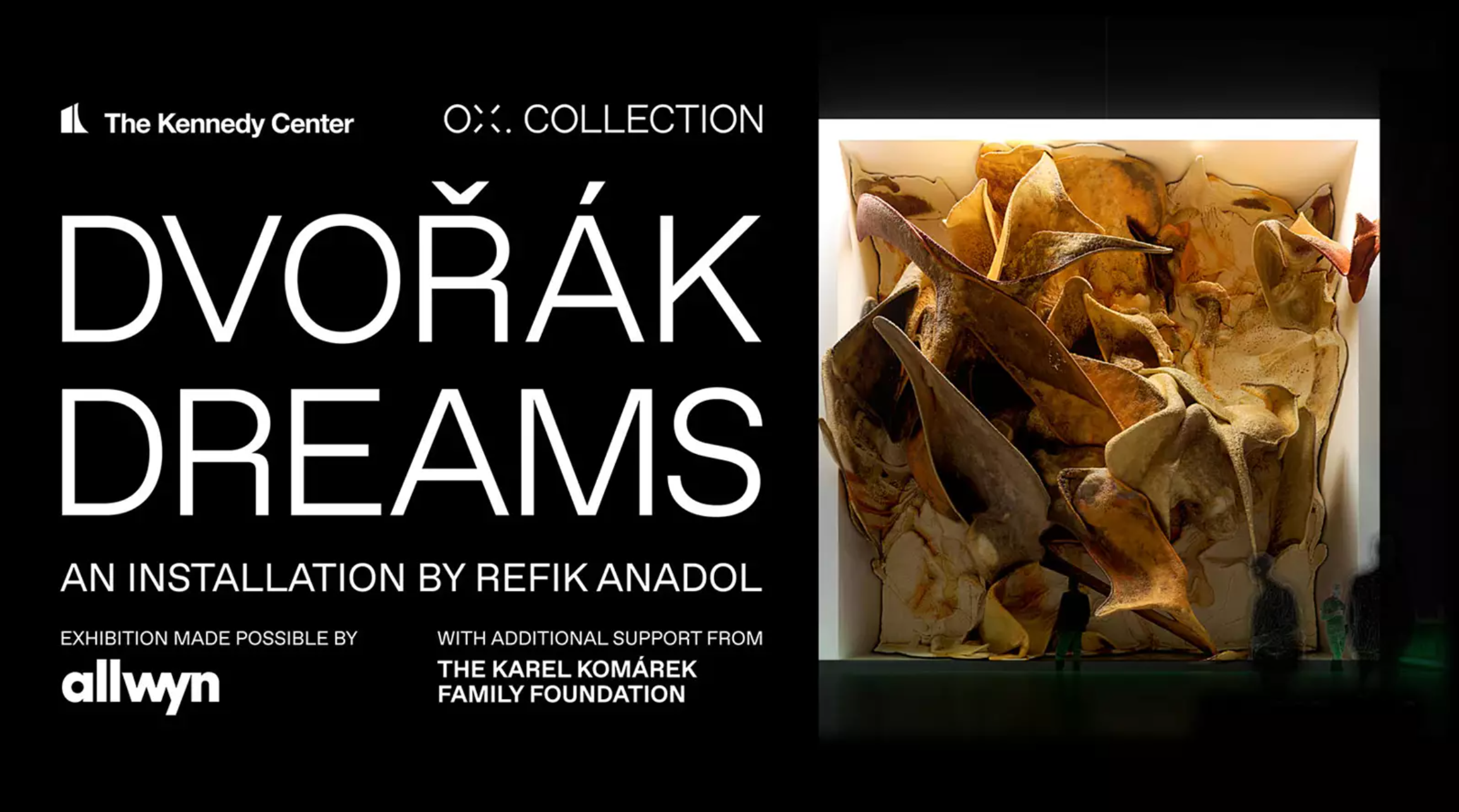
<p><img src="/assets/images/2024-09-19/flyer.png" alt="Flyer for Dvorak Dreams" /></p>

<p>I’ve only experienced Anadol’s work online—though videos, social media posts, and undergrad presentations on the state of the new media world—but I’ve always been skeptical of the hype. I could never explain why I disliked his work so much, but a couple of years ago, I read a critique of his installation at the MoMa that has helped me verbalize my distaste. For a critique in e-flux journal, <a href="https://www.e-flux.com/criticism/527236/refik-anadol-s-unsupervised" target="_blank">R.H. Lossin argues that “Unsupervised” (2022) is propaganda for surveillance</a>, invisibly harvesting data from its viewers to create an experience that is unseeming, meditative, ambiguously aesthetic. Something about the <em>unseemingness</em> of Anadol’s work bothered me: it felt too easy, too superficial to merit such acclaim, but everyone seems to like it. The propaganda works.</p>

<p>But I’ve never seen an Anadol piece in person, and I thought maybe I’d give him the benefit of the doubt. So on September 4, I pulled up to the REACH—an outdoor plaza on the roof of the Kennedy Center—for the United States premiere of Anadol’s installation “Dvořák Dreams.”</p>

<p>After five minutes on the lawn, I decided I’d seen all that needed to be seen of the installation and that the food trucks would be the best part of the night.</p>

<video width="100%" height="500" autoplay="" controls="">
    <source src="/assets/images/2024-09-19/20240904_195434.mp4" type="video/mp4" />
</video>

<p>It was pretty much what I expected from online: a massive LED display of looped AI-generated video. As with many of Anadol’s LED installations, he plays with the image of a “frame” built into the flat screen: his visuals morph from one form to another using particles that bounce like waves against the screen’s illusory “frame,” colliding with an imaginary panel that acts as the installation’s fourth wall. It looked pretty cool, actually. It got me thinking about how to re-create that effect in TouchDesigner. But what I found most disappointing about the piece was the complete lack of anything to do with the composer’s life or music.</p>

<p>“Dvořák Dreams” bears the name of a classical Czech composer whose most famous work, <a href="https://www.youtube.com/watch?v=2fFnxMY4cew" target="_blank">“New World Symphony,”</a> notably derives from African American and Native American spirituals. After Antonin Dvořák (1941-1904) came to New York in 1892 to direct the National Conservatory, Dvořák learned of spirituals such as “Swing Low, Sweet Chariot” from his assistant <a href="https://www.loc.gov/item/ihas.200035730" target="_blank">H.T. Burleigh</a> (1966-1949), a Black classical composer from Pennsylvania. Enamored and impressed with the music, <a href="https://pages.stolaf.edu/americanmusic/2021/10/12/african-american-spirituals-and-dvoraks-new-world-symphony/" target="_blank">Dvořák eventually declared “Negro melodies” the foundation of any “serious and original school of composition… in the United States.”</a></p>

<p>Whether we condemn his appropriation or praise it as radical for his time, Dvořák was a precedent to the likes of Elvis Presley and Led Zeppelin, white musicians who lifted their success from the uncredited heritage of Black musical traditions. Yet Anadol’s installation flattened the composer’s repetoire and influences with generic electronic ambiance. Anadol created the soundscape by training an AI model on archival Dvořák recordings, and the sounds of New York City and Prague, yet none of this I would have known if I hadn’t read the piece’s description. The only visible nod to Dvořák at all was an AI-generated segment bearing his image, conducting an AI-generated opus with blurry AI-generated hands.</p>

<p>If this was a commentary on the eploitative origins of both AI and Western music, well, the message didn’t come across.</p>

<p>A small monitor beside the installation claimed that “Dvořák Dreams” was an homage to “cultural heritage and creative innovation.” To claim “cultural heritage” while overlooking the influence of historically oppressed peoples on Dvořák’s most famous work is oversight enough. But beyond that, walking away from the installation, I would never have even known that Dvořák was from Prague.</p>

<p><img src="/assets/images/2024-09-19/20240904_195418.jpg" alt="Picture standing in front of Dvorak Dreams" /></p>

<p>Recently, I’ve realized that my <em>need</em> to find deeper meaning in art has prevented me from being creative at all. College trained me to view artworks as embodiments of history, applications of theory, metaphors for the human experience. Sometimes, it’s just not that deep. No need to be so holier-than-thou.</p>

<p>I respect Refik Anadol for attaining commercial success and worldwide influence as an artist, and I respect his installations as an introductory lesson to the new media world. I’m just biased because I’ve sat through so many student “as-our-first-assignment-research-a-piece-of-new-media-art” presentations about the same old shit that he does. But then again, introductory lesson. If seeing “Dvořák Dreams” turns someone on to the new media world for the first time, and they go on to create cool things, I can’t complain about that.</p>

<p>But I still stand by my opinion that the D.C. sunset stole the show.</p>

<p><img src="/assets/images/2024-09-19/20240904_194739.jpg" alt="&quot;Dvorak Dreams&quot; in front of the DC sunset." /></p>

<hr />

<p><em>Dvořák Dreams by Refik Anadol was on display at the Kennedy Center’s REACH plaza from Sept. 4-24. Admission: free.</em></p>]]></content><author><name></name></author><category term="500-1000" /><category term="words," /><category term="review," /><category term="installation," /><category term="music" /><summary type="html"><![CDATA[As UR LOCAL HATER of Refik Anadol’s work, when I heard he debuting an exhibit in D.C., I knew I had to see it for myself.]]></summary></entry><entry><title type="html">(UNFINISHED) Jill McCarthy Stauffer brings back my nostalgia for the waves</title><link href="https://seenby.urlocalcyb.org/2024/05/31/Palinopsia-@-Stamp-Gallery-UMD.html" rel="alternate" type="text/html" title="(UNFINISHED) Jill McCarthy Stauffer brings back my nostalgia for the waves" /><published>2024-05-31T00:00:00+00:00</published><updated>2024-05-31T00:00:00+00:00</updated><id>https://seenby.urlocalcyb.org/2024/05/31/Palinopsia%20@%20Stamp%20Gallery%20UMD</id><content type="html" xml:base="https://seenby.urlocalcyb.org/2024/05/31/Palinopsia-@-Stamp-Gallery-UMD.html"><![CDATA[<p><small>(April 2025 note: this post is an unfinished review of the exhibit <em>PALINOPSIA</em> at the University of Maryland Stamp Gallery, May 2024. The exhibit featured Jill McCarthy Stauffer, Margaret Walker, Trevan Jakaar Coleman, and Varvara Tokareva. I only finished writing about Jill McCarthy Stauffer’s pieces, and I have since lost my phone and documentation of the exhibit, but I wanted to post this anyways because I am happy with the writing.)</small></p>

<hr />

<p>The constant whisper of waves underlining McCarthy Stauffer’s electronic installations provided the only sound in the gallery. These installations used wired circuitboards and LED light to reconstruct creatures of the sand: oysters, sanderlings, horseshoe crabs beached around a glowing pearl. I’ve always lived near the coast, and the footprints in the sand mounds and the swaying sound of the sea brought me back to my family’s visits to La Jolla, Virginia Beach, Ocean City. But the vibrant lights outlining McCarthy Stauffer’s sculptures defamiliarized their wildlife, casting them into an artificial bioluminescence more saturated than anything in the natural world. These magentas and cyans were exaggeratedly manmade, an overload of RGB that couldn’t have come from anything else but a machine.</p>

<p>McCarthy Stauffer’s cyborg creatures glowed with otherworldly beauty and eye-catching whimsy, recalling a time in our childhoods where these creatures were alien. In the Stamp Gallery, we can relieve the first time a horseshoe crab brushed by our ankles, or the armfuls of seashells we collected from the sand because each shell was something new. The beach is an interface between land and sea, yes, but also between the tourist-packed boardwalk and the unexplored. Once upon a time, an jelly would have been as uncanny to us as an anglerfish. But we welcomed this new encounter, still too young to be scared.</p>

<p>The hypermediated wildlife doesn’t scare us, then, but just steps away are unsettling visuals by Varvara Tokareva. In her installation Utopia, consisting of two walls of prints and three video screens, Tokareva deforms footage from the 1980 Moscow Olympics with AI, transforming the arena into waxy meshes of limbs. The athletes appear to stand on each others’ shoulders, wearing identical uniforms, skin-tight yet sexless. Upon close inspection, some appear to be melting into each other; some are missing heads.</p>

<hr />

<p><small>draft ends here.</small></p>]]></content><author><name></name></author><category term="500-1000" /><category term="words," /><category term="review," /><category term="ai," /><category term="installation" /><summary type="html"><![CDATA[(April 2025 note: this post is an unfinished review of the exhibit PALINOPSIA at the University of Maryland Stamp Gallery, May 2024. The exhibit featured Jill McCarthy Stauffer, Margaret Walker, Trevan Jakaar Coleman, and Varvara Tokareva. I only finished writing about Jill McCarthy Stauffer’s pieces, and I have since lost my phone and documentation of the exhibit, but I wanted to post this anyways because I am happy with the writing.)]]></summary></entry><entry><title type="html">DANCExDANCE @ UMD’s Moving with Screens + Machines Symposium</title><link href="https://seenby.urlocalcyb.org/2024/05/06/DANCExDANCE.html" rel="alternate" type="text/html" title="DANCExDANCE @ UMD’s Moving with Screens + Machines Symposium" /><published>2024-05-06T00:00:00+00:00</published><updated>2024-05-06T00:00:00+00:00</updated><id>https://seenby.urlocalcyb.org/2024/05/06/DANCExDANCE</id><content type="html" xml:base="https://seenby.urlocalcyb.org/2024/05/06/DANCExDANCE.html"><![CDATA[<p><em>When I first started this blog, I was determined to leave my institution out of it. But I said last post that UR LOCAL CYBORG has now become a travelogue of me running around the DMV to review my professors’ work. At this point, I’ve fully embraced it. For this post, I didn’t have to run very far to write the review: DANCE^2 was part of the <a href="https://arts.umd.edu/moving-screens-machines">“Moving With Screens + Machines”</a> that took place right on campus.</em></p>

<p><em>MWS+M was organized by Professor Kate Ladenheim, who taught my motion capture class… which I unfortunately dropped on a stress-induced whim right before the deadline to withdraw. But they weren’t getting rid of me that easily! One of our assignments was to either volunteer at the symposium or to attend an event and write a reflection. Ya ‘borg didn’t quite get the memo that dropping class = less work because they’re doing both.</em></p>

<hr />

<iframe width="560" height="315" src="https://www.youtube.com/embed/QAyNIxWLHjc?si=nk8EfWgpULi93UMZ" title="YouTube video player" frameborder="0" allow="accelerometer; autoplay; clipboard-write; encrypted-media; gyroscope; picture-in-picture; web-share" referrerpolicy="strict-origin-when-cross-origin" allowfullscreen=""></iframe>

<p>The brainchild of dance, theater, immersive media, and robotics faculty at the University of Maryland, <em>DANCE^2</em> is an interactive dance performance x human-computer interaction study featuring wearable robots. The half-hour performance showcases the Calico, a miniature robot developed by the University of Maryland’s Small Artifacts Lab, as it buzzes and glows and maneuvers across the dancers’ suits. <em>DANCE^2</em> responds to its audience, and according to our hopes and fears, the robot can shapeshift from endearing little pet to a surveilling device patrolling the limbs of its host.</p>

<p>As audience members, we experience this performance on stage alongside the dancers and stagehands. This gave me a close-up appreciation of the costumes, which looked like the wardrobe of a sci-fi movie. While the stagehands wore the archetypical lab coat of a mad scientist (some themselves were university faculty), the dancers wore sleek white suits like Yelena’s from <em>Black Widow</em>, sewn with helical tracks for the robots to move. As the experience unfolded around us, a disembodied robotic voice prompted us to arrange ourselves onstage as determined by our relationship to technology: walk to the purple lights if you use a smartwatch, walk to the yellow if you don’t.</p>

<p>But the bulk of our interaction with <em>DANCE^2</em> came through a mobile app—a timely twist from the traditional request to silence our phones at the door. At the beginning of the performance, we scanned a QR code that led to a Qualtrics-esque interface (they really didn’t let us forget that we were their lab rats). At multiple points in the performance, the robotic voice read aloud a multiple-choice question, a bar graph was projected on stage, and we were asked to answer the question on our phones. More often than not, there were only two options: a hopeful response, a jaded one, nothing in-between.</p>

<p>For some questions we were neck and neck. What will technology feel like in the future? Hostile or friendly? We were a group of thirty on a tightrope walking the line between dry honesty and naive optimism. Participating in this performance brought me back to Cookie Clicker, or maybe Kahoot, watching the bar graphs teeter with our votes. I wonder how everyone else experienced it, because for a performance that responded to the audience as a single being, the experience itself was intimate and individual, confronting me with what was in my own head. My first instinct was to answer each question more critically—but mid-performance, sometimes mid-question, I found myself switching sides, clicking desperately for puppies and hope.</p>]]></content><author><name></name></author><category term="500-1000" /><category term="words," /><category term="dance," /><category term="live," /><category term="performance," /><category term="robots," /><category term="umd," /><category term="review" /><summary type="html"><![CDATA[When I first started this blog, I was determined to leave my institution out of it. But I said last post that UR LOCAL CYBORG has now become a travelogue of me running around the DMV to review my professors’ work. At this point, I’ve fully embraced it. For this post, I didn’t have to run very far to write the review: DANCE^2 was part of the “Moving With Screens + Machines” that took place right on campus.]]></summary></entry><entry><title type="html">Multisensory Meltdown @ Culture House DC</title><link href="https://seenby.urlocalcyb.org/2024/04/14/multisensory-meltdown.html" rel="alternate" type="text/html" title="Multisensory Meltdown @ Culture House DC" /><published>2024-04-14T00:00:00+00:00</published><updated>2024-04-14T00:00:00+00:00</updated><id>https://seenby.urlocalcyb.org/2024/04/14/multisensory-meltdown</id><content type="html" xml:base="https://seenby.urlocalcyb.org/2024/04/14/multisensory-meltdown.html"><![CDATA[<p>Sometimes being UR LOCAL CYBORG while a full-time student means I’m running around reviewing my instructors’ work, in which case it’s quite lucky that my department has artsy faculty. In this post I’m reviewing a production by the Immersive Media Design technician and instructor for my Capstone course, Ian McDermott. In March, Ian rounded up a group of IMD students to help set up for an event at Culture House, a ““multisensory meltdown”” of an indie rock show where he debuted the VR music video he created for <a href="https://thenorthcountry.bandcamp.com/album/the-futures-all-we-need">The North Country</a>’s song ““Inside Outside.””</p>

<p>I’m writing this review from the perspective of a VR docent, which I’ve done for plenty an IMD showcase or XR Club event. I’ve taken for granted the importance of human docents for VR exhibitions given that most of the VR exhibitions I’ve seen were right here on the University of Maryland’s campus, which is teeming with undergrads more than willing to spend a night on their feet to help people experience good art. As I touched on in a <a href="https://seenby.urlocalcyb.org/pearls-of-wonder-qaic/">previous review</a>, the most successful VR installations I’ve been to have a set of hands helping you get into and out of the headset, whether this is your first time in VR or your hundredth.</p>

<p><img src="https://bear-images.sfo2.cdn.digitaloceanspaces.com/urlocalcyborg-1713125204-0.gif" alt="UR LOCAL CYBORG" /></p>

<p>Quick skim-through of the technical stuff: Ian’s music video was built for the VIVE VR headset, which were installed in six stations during the event. Four of the stations had the video as created; two had a stiller version for motion-sensitivity. Each station had the wired headset and the tracking cameras used to determine the headset’s position in space. The headset itself was hooked up to a Raspberry Pi hosting the video, which in turn was hooked up to a small monitor displaying on a flat screen what it looked like inside the headset. That way, people waiting their turn could get a preview of what they’d see–and the volunteer docents could tell when it was time to help the viewer out of the headset when the video ended.</p>

<p>The music video itself was a montage of cinematic shots with the band, morphing and panning in 3D space as iridescent point clouds against a black backdrop. Watching it feels like a fantasy dream sequence wherein memories construct themselves around you out of flower petals or pixie dust. ““Inside Outside”” was a good song for VR–hazy, psychedelic, and as Ian mentioned, one that he could still enjoy listening to after having heard it more than anyone ever. It was a good song in general. Although VR as a medium is meant to remove you from reality, the music video felt very grounded–the visuals themselves floated at a slow-enough pace for you to process the experience. And they were captured using photogrammetry, reflecting ordinary scenes with photorealistic depth.</p>

<p>While the final result is far from realistic, you can still feel that it takes place in the real world, which I think is more memorable than creating a spacey foreign world. It defies what I see as a trope of virtual reality in both aesthetics and function: hypersaturated, overstimulating artificial virtual environments for intense, action-heavy video games. In contrast, the VR music video for ““Inside Out”” was meditative and soothing, transporting you smoothly from scene to scene all while standing in the same physical place. It didn’t require any hand-controller interaction, allowing first-time VR users to ease right into it. (VR is overwhelming enough as it is for first-time users: although ““Inside Outside”” lasts about three and a half minutes, one viewer took off the headset about a minute in, remarking that they’d lost all sense of time while immersed in the space, feeling like they’d been submerged in a months-long coma.)</p>

<p>During breaks from my volunteer shifts–Ian insisted that we all enjoy the show–I watched parts of each band’s set. <a href="https://virg.bandcamp.com/">ViRG</a> was a delightful opener to this cyberpunk rock show, with their synthy grooves and space opera getup: sequined capes and shoes in the style of a DIY David Bowie. The North Country carried on the otherworldly atmosphere with a laser show by Zak Forrest, projected on the wall behind their drummer as they performed. The art-reviewer side of me wants to say something about mediation and liveness (before the live performance of ““Inside Outside,”” the band’s guitarist remarked, ““You heard it in VR, now here it is in… regular R””), but I’ve had enough citing sources for the moment. I don’t need Philip Auslander to tell me that I had a good time.</p>

<p><img src="https://bear-images.sfo2.cdn.digitaloceanspaces.com/urlocalcyborg-1713125190-0.gif" alt="UR LOCAL CYBORG" /></p>

<p>If you’re interested in VR in the art space, I’d recommend volunteering at least once as a VR docent. It makes for a better exhibition experience, and whether or not you’ve ever used VR, I’d imagine that the event hosts would appreciate the help and be willing to onboard you to the equipment. One afternoon a week into my freshman year, I volunteered as a VR docent for a student club having only used a Google Cardboard once before in a science museum. I got more VR experience than I’d ever had in my lifetime at that point, just onboarding people onto the Oculus headsets–and my five-minute onboarding was more than most people had been in VR anyways. Nothing like learning by teaching, right? (And besides, it might just be a free ticket to a good show.)</p>

<p>Anyways, I’d imagine that my opportunities to volunteer at VR screenings will be sparse after I graduate. But the DMV is a good area for XR and museum work, so I’ll keep an eye out.</p>

<hr />
<p><strong>The North Country’s ““Multisensory Meltdown”“</strong> show took place on Friday, March 29, 2024 at Culture House DC, featuring the bands ViRG and The North Country and multimedia works by Ian McDermott and Zak Forrest. Tickets: $25.</p>]]></content><author><name></name></author><category term="500-1000" /><category term="words," /><category term="concert," /><category term="laser," /><category term="live," /><category term="performance," /><category term="umd," /><category term="vr," /><category term="review" /><summary type="html"><![CDATA[Sometimes being UR LOCAL CYBORG while a full-time student means I’m running around reviewing my instructors’ work, in which case it’s quite lucky that my department has artsy faculty. In this post I’m reviewing a production by the Immersive Media Design technician and instructor for my Capstone course, Ian McDermott. In March, Ian rounded up a group of IMD students to help set up for an event at Culture House, a ““multisensory meltdown”” of an indie rock show where he debuted the VR music video he created for The North Country’s song ““Inside Outside.”” I’m writing this review from the perspective of a VR docent, which I’ve done for plenty an IMD showcase or XR Club event. I’ve taken for granted the importance of human docents for VR exhibitions given that most of the VR exhibitions I’ve seen were right here on the University of Maryland’s campus, which is teeming with undergrads more than willing to spend a night on their feet to help people experience good art. As I touched on in a previous review, the most successful VR installations I’ve been to have a set of hands helping you get into and out of the headset, whether this is your first time in VR or your hundredth. Quick skim-through of the technical stuff: Ian’s music video was built for the VIVE VR headset, which were installed in six stations during the event. Four of the stations had the video as created; two had a stiller version for motion-sensitivity. Each station had the wired headset and the tracking cameras used to determine the headset’s position in space. The headset itself was hooked up to a Raspberry Pi hosting the video, which in turn was hooked up to a small monitor displaying on a flat screen what it looked like inside the headset. That way, people waiting their turn could get a preview of what they’d see–and the volunteer docents could tell when it was time to help the viewer out of the headset when the video ended. The music video itself was a montage of cinematic shots with the band, morphing and panning in 3D space as iridescent point clouds against a black backdrop. Watching it feels like a fantasy dream sequence wherein memories construct themselves around you out of flower petals or pixie dust. ““Inside Outside”” was a good song for VR–hazy, psychedelic, and as Ian mentioned, one that he could still enjoy listening to after having heard it more than anyone ever. It was a good song in general. Although VR as a medium is meant to remove you from reality, the music video felt very grounded–the visuals themselves floated at a slow-enough pace for you to process the experience. And they were captured using photogrammetry, reflecting ordinary scenes with photorealistic depth. While the final result is far from realistic, you can still feel that it takes place in the real world, which I think is more memorable than creating a spacey foreign world. It defies what I see as a trope of virtual reality in both aesthetics and function: hypersaturated, overstimulating artificial virtual environments for intense, action-heavy video games. In contrast, the VR music video for ““Inside Out”” was meditative and soothing, transporting you smoothly from scene to scene all while standing in the same physical place. It didn’t require any hand-controller interaction, allowing first-time VR users to ease right into it. (VR is overwhelming enough as it is for first-time users: although ““Inside Outside”” lasts about three and a half minutes, one viewer took off the headset about a minute in, remarking that they’d lost all sense of time while immersed in the space, feeling like they’d been submerged in a months-long coma.) During breaks from my volunteer shifts–Ian insisted that we all enjoy the show–I watched parts of each band’s set. ViRG was a delightful opener to this cyberpunk rock show, with their synthy grooves and space opera getup: sequined capes and shoes in the style of a DIY David Bowie. The North Country carried on the otherworldly atmosphere with a laser show by Zak Forrest, projected on the wall behind their drummer as they performed. The art-reviewer side of me wants to say something about mediation and liveness (before the live performance of ““Inside Outside,”” the band’s guitarist remarked, ““You heard it in VR, now here it is in… regular R””), but I’ve had enough citing sources for the moment. I don’t need Philip Auslander to tell me that I had a good time. If you’re interested in VR in the art space, I’d recommend volunteering at least once as a VR docent. It makes for a better exhibition experience, and whether or not you’ve ever used VR, I’d imagine that the event hosts would appreciate the help and be willing to onboard you to the equipment. One afternoon a week into my freshman year, I volunteered as a VR docent for a student club having only used a Google Cardboard once before in a science museum. I got more VR experience than I’d ever had in my lifetime at that point, just onboarding people onto the Oculus headsets–and my five-minute onboarding was more than most people had been in VR anyways. Nothing like learning by teaching, right? (And besides, it might just be a free ticket to a good show.) Anyways, I’d imagine that my opportunities to volunteer at VR screenings will be sparse after I graduate. But the DMV is a good area for XR and museum work, so I’ll keep an eye out. The North Country’s ““Multisensory Meltdown”“ show took place on Friday, March 29, 2024 at Culture House DC, featuring the bands ViRG and The North Country and multimedia works by Ian McDermott and Zak Forrest. Tickets: $25.]]></summary></entry><entry><title type="html">On Dance, Mediation, &amp;amp; The Start of the Final Semester</title><link href="https://seenby.urlocalcyb.org/2024/02/18/dance-thesis.html" rel="alternate" type="text/html" title="On Dance, Mediation, &amp;amp; The Start of the Final Semester" /><published>2024-02-18T00:00:00+00:00</published><updated>2024-02-18T00:00:00+00:00</updated><id>https://seenby.urlocalcyb.org/2024/02/18/dance-thesis</id><content type="html" xml:base="https://seenby.urlocalcyb.org/2024/02/18/dance-thesis.html"><![CDATA[<p>One of my English professors this fall advised us to engage in art forms that we didn’t know shit about. I’ve been taking that to heart. In September, I met a dance MFA student on campus, and incidentally discovered our shared obsession with cyborgs and cyberfeminist theory. I attended their <a href="https://theclarice.umd.edu/events/2024/spring-mfa-dance-thesis-concert">thesis show</a> Friday night.</p>

<p>The concert featured three performances, three theses I assumed, and I realized that all of them incorporated video projection. One projected a portal of water and flame, one scrolled the words of a poem backwards against the backdrop and bodies of the performers. During the last performance—the dance thesis of the MFA student I’d talked to—I found myself trying to reverse-engineer their projection from the perspective of a spectator: was it pre-recorded or generated in real time? TouchDesigner or Unity? I remembered a software that <a href="https://www.iamtommybobo.com/">one faculty member</a> had showed me earlier this semester, while demonstrating video synths: <a href="https://cycling74.com/">Max by Cycling ‘74</a>. They had used Max to program their light installations, but from what I understood, Max can do a lot of A/V choreography for stage and live performance.</p>

<p>I’m taking a motion-capture class right now, and while most students are from <a href="https://imd.umd.edu/">my own department</a>, the lecturer, grad students, and grad TA bring to the studio a background of theater, dance, performance, and art history, all far outside of my area-of-undergraduate-expertise. Of course I knew this already, but nothing hammers it harder than your last semester of senior year: there is so much I have yet to learn. Although my degree program boasts the label “multidisciplinary,” I’m realizing that it’s kind of boxed us into a discipline of no discipline: a program for high school graduates who like multiple things but have no formal training in any of them. I wish early on that we were introduced to more art history than what revolves around the digital screen. While applying to college, I was frustrated that all of the <a href="https://mith.umd.edu/">cool</a> <a href="https://advanced.jhu.edu/academics/graduate/ma-film-media/iset-concentration/">multidisciplinary</a> <a href="https://www.etc.cmu.edu/">tech+art</a> <a href="https://www.dsah.umd.edu/">programs</a> were for grad school. Now I’m starting to understand why.</p>

<p>Not that I want to go to grad school quite yet, but it kind of bums me out that I’m only just starting to get into the fun stuff in my final semester. I’m glad that my 400-levels are breaking the echo chamber that is a new major that no one quite knows what to do with, but I wish this started happening in sophomore year. (I was going to say “freshman” but then I realized starting college itself is culture shock enough.)</p>

<p>Back to the thesis show. I know this blog is about “new media art reviews” but I don’t know how to review it other than just saying it was mad cool. I don’t have the terminology, yet, to describe the stories told by a moving body. I don’t even know if a dance show even “counts” as “new media art” just because it had a couple of projections, because the whole point of the show is the dancers, not the props. Is dance even considered a medium? The movement of the live body through thin air is ephemeral, traceless, on its own. The film that captures it, the painting that recreates it, the footprints on the ground were the stage made of wet clay—the material recording that freezes a moment in time is the medium, from my understanding of what “medium” means.</p>

<p>I was just digging through my last semester’s notes to find <em>where</em> it was that Philip Auslander said that live performance was not a medium. I realized that he never said that, but rather wrote that “live performance and mass media are rivals on the scale of David and Goliath” while discussing the use of recorded media in ephemeral performance. A rock band will light up their arena stage with a live feed of their performance for squinting fans in the nosebleeds. A karaoke party will blast the YouTube lyric videos for the tipsy performers. MFA students will generate audiovisual projections for their cyborg dance thesis. My friend is trying to start a livecoding scene in the DMV, like the ones in <a href="https://www.instagram.com/bostontechpoetics/">Boston</a>, <a href="https://www.instagram.com/livecoderva/">Richmond</a>, and <a href="https://www.instagram.com/livecodenyc/">New York</a>. I’m drawn to this kind of thing in the same way I’m drawn to the MCU’s Loki and Thor: rivals, then hand-in-hand.</p>

<p>So much digital innovation has been driven by the dream of disembodiment: the <a href="https://smg.media.mit.edu/library/nakamura1995.html">early Internet envisioned as a utopia</a> where race, sex, and disability don’t matter; today’s VR headsets that promise to uproot you to another world. The stereotype of the lazy software engineer living off pizza in their parents’ basement. Growing up, I was never an athlete or an actor or a dancer. I was an Elphaba, hiding my face and shying away from any situation where I was forced to perform, to put my body in front of other people. This is the shit I know about, and I’d imagine a lot of people who work with technology and digital media grew up in the same way.</p>

<p>That is why the intersection of mediation and performance, the worlds of <a href="https://www.doubleeye.co/">VR theater</a> and <a href="https://www.kateladenheim.com/portfolio/commit">live MoCap performance</a>, have caught my attention. It’s not a combination that your desk job tech geek will have dreamed up. Using technology in live performance is nothing new but it’s a whole field of art and media history that I was never exposed to, and I’m doing my best to seek out more.</p>]]></content><author><name></name></author><category term="500-1000" /><category term="words," /><category term="performance," /><category term="umd," /><category term="live," /><category term="dance," /><category term="video" /><summary type="html"><![CDATA[One of my English professors this fall advised us to engage in art forms that we didn’t know shit about. I’ve been taking that to heart. In September, I met a dance MFA student on campus, and incidentally discovered our shared obsession with cyborgs and cyberfeminist theory. I attended their thesis show Friday night. The concert featured three performances, three theses I assumed, and I realized that all of them incorporated video projection. One projected a portal of water and flame, one scrolled the words of a poem backwards against the backdrop and bodies of the performers. During the last performance—the dance thesis of the MFA student I’d talked to—I found myself trying to reverse-engineer their projection from the perspective of a spectator: was it pre-recorded or generated in real time? TouchDesigner or Unity? I remembered a software that one faculty member had showed me earlier this semester, while demonstrating video synths: Max by Cycling ‘74. They had used Max to program their light installations, but from what I understood, Max can do a lot of A/V choreography for stage and live performance. I’m taking a motion-capture class right now, and while most students are from my own department, the lecturer, grad students, and grad TA bring to the studio a background of theater, dance, performance, and art history, all far outside of my area-of-undergraduate-expertise. Of course I knew this already, but nothing hammers it harder than your last semester of senior year: there is so much I have yet to learn. Although my degree program boasts the label “multidisciplinary,” I’m realizing that it’s kind of boxed us into a discipline of no discipline: a program for high school graduates who like multiple things but have no formal training in any of them. I wish early on that we were introduced to more art history than what revolves around the digital screen. While applying to college, I was frustrated that all of the cool multidisciplinary tech+art programs were for grad school. Now I’m starting to understand why. Not that I want to go to grad school quite yet, but it kind of bums me out that I’m only just starting to get into the fun stuff in my final semester. I’m glad that my 400-levels are breaking the echo chamber that is a new major that no one quite knows what to do with, but I wish this started happening in sophomore year. (I was going to say “freshman” but then I realized starting college itself is culture shock enough.) Back to the thesis show. I know this blog is about “new media art reviews” but I don’t know how to review it other than just saying it was mad cool. I don’t have the terminology, yet, to describe the stories told by a moving body. I don’t even know if a dance show even “counts” as “new media art” just because it had a couple of projections, because the whole point of the show is the dancers, not the props. Is dance even considered a medium? The movement of the live body through thin air is ephemeral, traceless, on its own. The film that captures it, the painting that recreates it, the footprints on the ground were the stage made of wet clay—the material recording that freezes a moment in time is the medium, from my understanding of what “medium” means. I was just digging through my last semester’s notes to find where it was that Philip Auslander said that live performance was not a medium. I realized that he never said that, but rather wrote that “live performance and mass media are rivals on the scale of David and Goliath” while discussing the use of recorded media in ephemeral performance. A rock band will light up their arena stage with a live feed of their performance for squinting fans in the nosebleeds. A karaoke party will blast the YouTube lyric videos for the tipsy performers. MFA students will generate audiovisual projections for their cyborg dance thesis. My friend is trying to start a livecoding scene in the DMV, like the ones in Boston, Richmond, and New York. I’m drawn to this kind of thing in the same way I’m drawn to the MCU’s Loki and Thor: rivals, then hand-in-hand. So much digital innovation has been driven by the dream of disembodiment: the early Internet envisioned as a utopia where race, sex, and disability don’t matter; today’s VR headsets that promise to uproot you to another world. The stereotype of the lazy software engineer living off pizza in their parents’ basement. Growing up, I was never an athlete or an actor or a dancer. I was an Elphaba, hiding my face and shying away from any situation where I was forced to perform, to put my body in front of other people. This is the shit I know about, and I’d imagine a lot of people who work with technology and digital media grew up in the same way. That is why the intersection of mediation and performance, the worlds of VR theater and live MoCap performance, have caught my attention. It’s not a combination that your desk job tech geek will have dreamed up. Using technology in live performance is nothing new but it’s a whole field of art and media history that I was never exposed to, and I’m doing my best to seek out more.]]></summary></entry><entry><title type="html">Pearls of Wonder @ Qatar America Institute for Culture</title><link href="https://seenby.urlocalcyb.org/2023/12/08/pearls-of-wonder.html" rel="alternate" type="text/html" title="Pearls of Wonder @ Qatar America Institute for Culture" /><published>2023-12-08T00:00:00+00:00</published><updated>2023-12-08T00:00:00+00:00</updated><id>https://seenby.urlocalcyb.org/2023/12/08/pearls-of-wonder</id><content type="html" xml:base="https://seenby.urlocalcyb.org/2023/12/08/pearls-of-wonder.html"><![CDATA[<p>It was three in the afternoon when I visited the Qatar America Institute for Culture (QAIC) last month. But the curtains were closed on the third floor, the dark rooms lit only by the flickering LED of digital projections. In the artificial blue light, I felt like I was underwater.</p>

<p><img src="https://bear-images.sfo2.cdn.digitaloceanspaces.com/urlocalcyborg-1702051735-0.jpg" alt="UR LOCAL CYBORG" /></p>

<p>Originally showcased in New York City, <em>Pearls of Wonder</em> is a multisensory exhibit that came to Washington, D.C. this summer. It features the work of five Qatari artists—Maryam Al Homaid, Alanoud Al-Buainain, May Almannai, Saida Al-Khulaifi, and Mohammed Faraj Al-Suwaidi—depicting the country’s history of pearl diving. Before oil became its main export, Qatar was renowned for its pearl production, a trade rooted in thousands of years of tradition and grueling labor. Pearl divers spent their summers at sea, holding their breaths for 50-foot dives to collect oysters by hand. They worked under perilous conditions, dodging sharks and stingrays only to return to the cramped, disease-ridden ship that transported the divers.</p>

<p>The first time I visited <em>Pearls of Wonder</em> was during Dupont ArtWalk, an event where arts venues around the Dupont Circle area open their doors to visitors on the first Friday evening of each month. I was with my family, and we arrived at the QAIC shortly before it closed. I had just enough time for a quick look around, a glance into the VR installation in the leftmost room. An Oculus Quest headset was mounted on a lonely wall. No one touched it. But I was curious, and I knew how to work the thing, so I put it over my head. It didn’t turn on.</p>

<p>But I knew I had to visit again, so I scheduled a tour for the one Tuesday where my class held during the exhibition time was canceled. My favorite piece was Maryam Al-Homaid’s “Singing Narratives Within The Deep Sea,” presented as a video projected on white cloth in the second room I visited. The piece pairs archival footage with the text of a poem, blooming across the projection in glowing, Arabic bubble-letters in percussive rhythm to Arabic chants. I can neither read nor understand the language, so I would have assumed that the spoken word was a reading (or as it seemed, singing) of them poem’s text. But my tour guide told me that it was a recording of a prayer that pearl divers would chant before submerging into the sea.</p>

<p>&lt;video width=”“100%”” height=”“auto”” controls&gt;
&lt;source src=”“https://cdn.discordapp.com/attachments/896421660834529291/1182709720545501344/20231107_154753.mp4?ex=6585af43&amp;is=65733a43&amp;hm=54cdfc20b21159f664d4953eaf730668ee236a5dece293ba3c6d3608a43e5e16&amp;”” type=”“video/mp4””&gt;
&lt;/video&gt;</p>

<p>Part of the reason why I returned to the QAIC was to see the virtual reality piece on display. Unfortunately, there was no headset in sight in the installation of Mohammed Faraj Al-Suwaidi’s ““Bubbles and Pearls.”” But I saw, on the windowsill where the headsets were mounted originally, a sheet of instructions for running the virtual reality experience. Seemed like it was meant to give viewers a taste of the pearl diving experience—the challenge without the peril—in virtual reality. I asked staff where the VR piece went, and apparently something wasn’t working so they had to send the piece back to the artist to fix it. I wonder what broke. The piece had been showcased before, so… a Meta SDK change? Damaged hardware?</p>

<p><img src="https://bear-images.sfo2.cdn.digitaloceanspaces.com/urlocalcyborg-1702052507-0.jpg" alt="UR LOCAL CYBORG" /></p>

<p>As I prepare to install my own VR piece for a class project, I’m reckoning with how to present virtual reality for public viewing. The best experiences I’ve had with VR art installations have been with student work on campus, where student volunteers or the artists themselves were in the installation space helping viewers get set up. Most people have never used virtual reality before—it’s not enough just to drop the headset next to an instructions card and hope visitors figure it out. On the other hand, I feel like Instagram filters are probably the best way today for an artist to platform an <em>augmented</em> reality installation as Al-Suwaidi’s piece did—even if this access is limited to people who use the app. Instagram’s filters come with built-in onboarding. I wish it didn’t have to be housed on such a commercial platform, but functionally Instagram provides an adequate infrastructure.</p>

<p>I also appreciated the projection installed alongside the virtual and augmented reality. Although it was a more passive experience than the artist likely envisioned for VR, the graphics were beautiful and I think gave me a stylistic and atmospheric taste of what I would have experienced in VR. The term ““immersion”” is a metaphor itself for submerging in water, and even without the VR I was able to do just that.</p>

<p>&lt;video width=”“100%”” height=”“auto”” controls&gt;
&lt;source src=”“https://cdn.discordapp.com/attachments/896421660834529291/1182709719564046448/VID_45240803_113840_600.mp4?ex=6585af42&amp;is=65733a42&amp;hm=49cdc707ccd91a5c81bf545c68108a19218c90b3b153dc841ebe742e6daf397e&amp;”” type=”“video/mp4””&gt;
&lt;/video&gt;</p>

<table>
  <tbody>
    <tr>
      <td>As with _MARMO</td>
      <td>Marble_, which I reviewed earlier this year, <em>Pearls of Wonder</em> was a showcase of international new media art in connection with a foreign embassy. I didn’t realize how big a contributor the geopolitical context of Washington, D.C. had in bringing new media artwork to the area. I started this blog to question what “local” meant in the new media world, and am now beginning to understand the range of experiences that come to us: from DIY-hosted experiments to international exhibitions.</td>
    </tr>
  </tbody>
</table>

<p><em>Pearls of Wonder</em> in general had me thinking about the role of digital media in preserving and remixing the past. I am taking a couple of digital humanities courses next semester, so the question is front of mind. Artists today are afforded automation—something that would have made life much, much easier for the pearl divers. It was interesting to see how these artists remixed analog archival materials of a once-manual trade to present it to a new audience of digital natives.</p>

<p>This is a partial review. I hope to come back—maybe make a part two to this review—since there was another tech/art exhibition I didn’t know was on view at the QAIC. During my visit, I learned of their 2023 theme “Technology &amp; the Arts” which informed their events and exhibits for the year. I was too late for most of them, but the <a href="https://qataramerica.org/2023-impart-artist-grant-winners-exhibition/"><em>IMPART</em> exhibition</a> is still open… I’ll have to go soon. It closes at the end of the year.</p>

<hr />

<p><strong><em>Pearls of Wonder: a digital era</em></strong> is on display at the Qatar America Institute for Culture until December 15. <a href="https://qaic-schedule-a-tour.as.me/schedule/861c055f">Appointments</a> can be booked in 30-minute slots online on Tuesday and Thursday afternoons.</p>]]></content><author><name></name></author><category term="projection," /><category term="exhibition," /><category term="video," /><category term="ar," /><category term="1000-1500" /><category term="words," /><category term="xr," /><category term="vr," /><category term="review" /><summary type="html"><![CDATA[It was three in the afternoon when I visited the Qatar America Institute for Culture (QAIC) last month. But the curtains were closed on the third floor, the dark rooms lit only by the flickering LED of digital projections. In the artificial blue light, I felt like I was underwater. Originally showcased in New York City, Pearls of Wonder is a multisensory exhibit that came to Washington, D.C. this summer. It features the work of five Qatari artists—Maryam Al Homaid, Alanoud Al-Buainain, May Almannai, Saida Al-Khulaifi, and Mohammed Faraj Al-Suwaidi—depicting the country’s history of pearl diving. Before oil became its main export, Qatar was renowned for its pearl production, a trade rooted in thousands of years of tradition and grueling labor. Pearl divers spent their summers at sea, holding their breaths for 50-foot dives to collect oysters by hand. They worked under perilous conditions, dodging sharks and stingrays only to return to the cramped, disease-ridden ship that transported the divers. The first time I visited Pearls of Wonder was during Dupont ArtWalk, an event where arts venues around the Dupont Circle area open their doors to visitors on the first Friday evening of each month. I was with my family, and we arrived at the QAIC shortly before it closed. I had just enough time for a quick look around, a glance into the VR installation in the leftmost room. An Oculus Quest headset was mounted on a lonely wall. No one touched it. But I was curious, and I knew how to work the thing, so I put it over my head. It didn’t turn on. But I knew I had to visit again, so I scheduled a tour for the one Tuesday where my class held during the exhibition time was canceled. My favorite piece was Maryam Al-Homaid’s “Singing Narratives Within The Deep Sea,” presented as a video projected on white cloth in the second room I visited. The piece pairs archival footage with the text of a poem, blooming across the projection in glowing, Arabic bubble-letters in percussive rhythm to Arabic chants. I can neither read nor understand the language, so I would have assumed that the spoken word was a reading (or as it seemed, singing) of them poem’s text. But my tour guide told me that it was a recording of a prayer that pearl divers would chant before submerging into the sea. &lt;video width=”“100%”” height=”“auto”” controls&gt; &lt;source src=”“https://cdn.discordapp.com/attachments/896421660834529291/1182709720545501344/20231107_154753.mp4?ex=6585af43&amp;is=65733a43&amp;hm=54cdfc20b21159f664d4953eaf730668ee236a5dece293ba3c6d3608a43e5e16&amp;”” type=”“video/mp4””&gt; &lt;/video&gt; Part of the reason why I returned to the QAIC was to see the virtual reality piece on display. Unfortunately, there was no headset in sight in the installation of Mohammed Faraj Al-Suwaidi’s ““Bubbles and Pearls.”” But I saw, on the windowsill where the headsets were mounted originally, a sheet of instructions for running the virtual reality experience. Seemed like it was meant to give viewers a taste of the pearl diving experience—the challenge without the peril—in virtual reality. I asked staff where the VR piece went, and apparently something wasn’t working so they had to send the piece back to the artist to fix it. I wonder what broke. The piece had been showcased before, so… a Meta SDK change? Damaged hardware? As I prepare to install my own VR piece for a class project, I’m reckoning with how to present virtual reality for public viewing. The best experiences I’ve had with VR art installations have been with student work on campus, where student volunteers or the artists themselves were in the installation space helping viewers get set up. Most people have never used virtual reality before—it’s not enough just to drop the headset next to an instructions card and hope visitors figure it out. On the other hand, I feel like Instagram filters are probably the best way today for an artist to platform an augmented reality installation as Al-Suwaidi’s piece did—even if this access is limited to people who use the app. Instagram’s filters come with built-in onboarding. I wish it didn’t have to be housed on such a commercial platform, but functionally Instagram provides an adequate infrastructure. I also appreciated the projection installed alongside the virtual and augmented reality. Although it was a more passive experience than the artist likely envisioned for VR, the graphics were beautiful and I think gave me a stylistic and atmospheric taste of what I would have experienced in VR. The term ““immersion”” is a metaphor itself for submerging in water, and even without the VR I was able to do just that. &lt;video width=”“100%”” height=”“auto”” controls&gt; &lt;source src=”“https://cdn.discordapp.com/attachments/896421660834529291/1182709719564046448/VID_45240803_113840_600.mp4?ex=6585af42&amp;is=65733a42&amp;hm=49cdc707ccd91a5c81bf545c68108a19218c90b3b153dc841ebe742e6daf397e&amp;”” type=”“video/mp4””&gt; &lt;/video&gt; As with _MARMO Marble_, which I reviewed earlier this year, Pearls of Wonder was a showcase of international new media art in connection with a foreign embassy. I didn’t realize how big a contributor the geopolitical context of Washington, D.C. had in bringing new media artwork to the area. I started this blog to question what “local” meant in the new media world, and am now beginning to understand the range of experiences that come to us: from DIY-hosted experiments to international exhibitions. Pearls of Wonder in general had me thinking about the role of digital media in preserving and remixing the past. I am taking a couple of digital humanities courses next semester, so the question is front of mind. Artists today are afforded automation—something that would have made life much, much easier for the pearl divers. It was interesting to see how these artists remixed analog archival materials of a once-manual trade to present it to a new audience of digital natives. This is a partial review. I hope to come back—maybe make a part two to this review—since there was another tech/art exhibition I didn’t know was on view at the QAIC. During my visit, I learned of their 2023 theme “Technology &amp; the Arts” which informed their events and exhibits for the year. I was too late for most of them, but the IMPART exhibition is still open… I’ll have to go soon. It closes at the end of the year. Pearls of Wonder: a digital era is on display at the Qatar America Institute for Culture until December 15. Appointments can be booked in 30-minute slots online on Tuesday and Thursday afternoons.]]></summary></entry></feed>